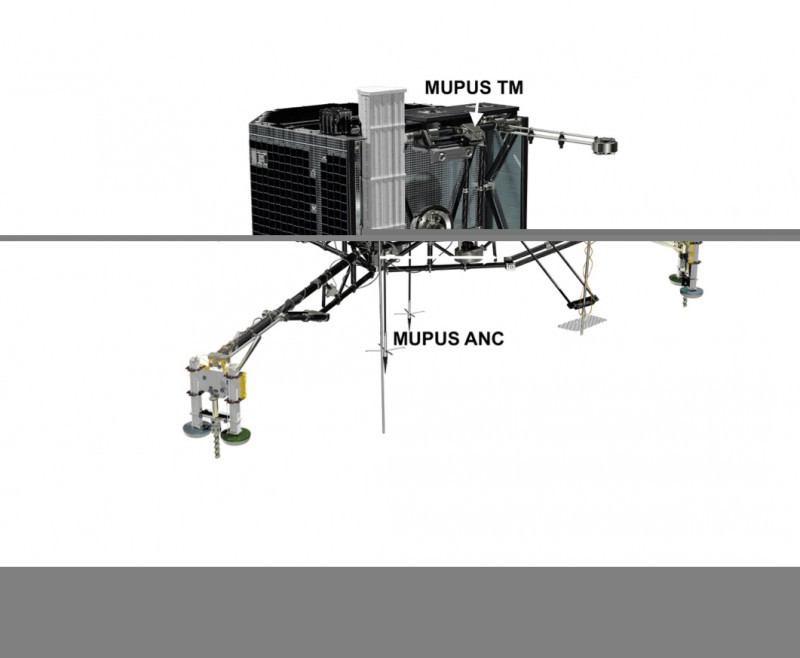
Landing module «Philae» with MUPUS.
ESA / ATG media lab
Comet Churyumov-Gerasimenko poses new riddles: Surface material measurements performed by the «Philae» landing module indicate that the near surface material might have changed since its formation. Up to now, many researchers had assumed that it has remained in virtually the same state since its formation about 4.5 billion years ago. The results of the study, in which researchers from the University of Bern were also involved, have been published in «Science» magazine. Hard like frozen firn snow instead of loose and soft like dust: Apparently, the material under the surface of Comet Churyumov-Gerasimenko is far harder than many experts had expected - this was the result from measurements by the 'Philae' comet lander at least. Karsten Seiferlin, planetologist and project manager at the Physics Institute at the University of Bern, was directly involved in the discovery and is the co-author of a 'Science' article, in which the measurement results were published. 'The solidification of the material indicates processes, which have sustainably changed the comet or are still changing it', he says. These findings are very significant for the Rosetta mission, 'It was originally assumed that comets have remained virtually unchanged since their formation, thus providing information about the formation of planets and comets.' However, the latest results from the 'Rosetta' mission have now showed that the possibility of changes needs to be taken into consideration.
TO READ THIS ARTICLE, CREATE YOUR ACCOUNT
And extend your reading, free of charge and with no commitment.