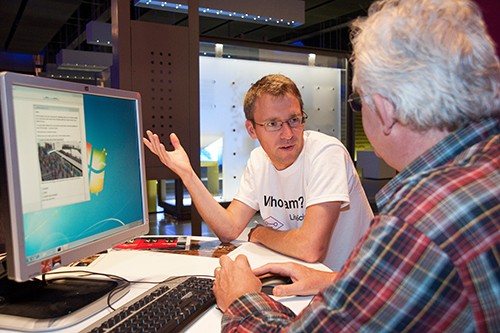
Dr Nikolai Bode at London’s Science Museum.
Jennie Hills
How do you encourage people in the midst of an emergency to stay calm and prioritise their safety over their possessions' University of Bristol researchers have devised a game which they believe could help, by encouraging players to be more risk-aware. Studies into human behaviour in emergencies have shown that the decisions people make during evacuations, be it the exit they choose or whether they collect their personal belongings, can cause significant delays. Evacuation drills can prove an effective remedy in improving safety and response, but they have limitations. For instance, testing the evacuation procedure for every large football stadium design before it is built would be prohibitively expensive. Increasingly, researchers are turning to mathematical or computational models to provide a solution, predicting how crowds of people might move through a building based on assumptions about ordinary human behaviour. "The trouble is, the assumptions and consequently the models, are not always accurate," said Dr Nikolai Bode , who has devised a series of virtual experiments, packaged as 'the Evac Game', which have been tested out on more than 4,000 people aged seven to 77, encouraging them to act out the way they would respond in an emergency. "Experiments can be expensive and simulating crowd evacuations could be stressful, meaning people might get hurt.
TO READ THIS ARTICLE, CREATE YOUR ACCOUNT
And extend your reading, free of charge and with no commitment.