Michaela Roschger has a creative mind, enjoys painting and conducting research into more efficient ethanol fuel cells.
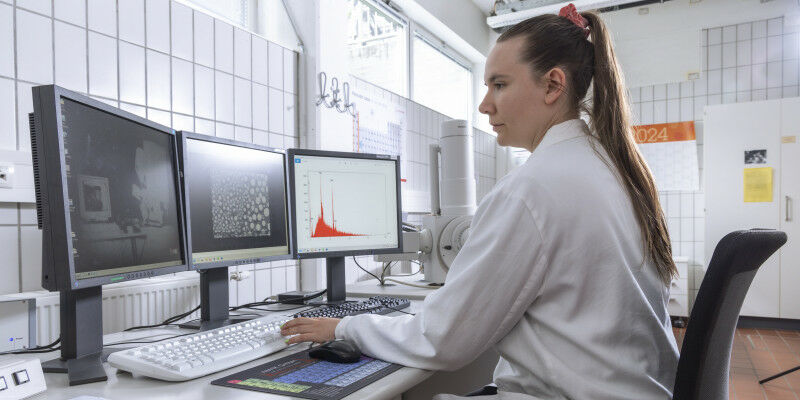
The young researcher is still at the beginning of her academic career, having completed her doctoral thesis at the Institute of Chemical Engineering and Environmental Technology at Graz University of Technology (TU Graz) last year after completing a BSc in Chemistry and a master’s in Technical Chemistry. Her field of research is the alkaline ethanol fuel cell, a promising candidate for an environmentally friendly energy supply. "Ethanol can be produced from biomass through fermentation and is very easy to transport and store because it’s a liquid," explains Roschger. Gaseous hydrogen, on the other hand, must be highly compressed in order to achieve high energy densities and thus efficient storage. However, the ethanol fuel cell is still a long way from achieving the performance that the classic hydrogen fuel cell can deliver. "The flow-field design, in other words the path that the ethanol takes to the electrodes, has to be optimised. As do the electrodes themselves. The catalyst material is not yet optimal and the catalyst layer also needs to be utilised more efficiently." Roschger is conducting intensive and successful research into these aspects. She was recently honoured with the Award of Excellence by the Federal Ministry of Education, Science and Research for her doctoral thesis.
During her stay in the USA, she is focusing on the possibility of electrochemically producing hydrogen from ethanol, building on her doctoral thesis. "Everyday university life in the USA is completely different to that in Austria. The whole campus is like a small, self-contained town and there is a lot on offer for students. In Graz, the university is much more integrated into the city. But the work in the lab is actually the same as at TU Graz."
Research to protect the environment
"It was always important to me to find a field of research that has a deeper meaning for the general public and contributes to environmental protection," explains the researcher. "My parents both studied physics, so my path to the natural sciences was somewhat predetermined." At secondary school, she took chemistry as a compulsory elective subject and also took part in the Chemistry Olympiad. "So I suddenly had six hours of chemistry a week. That was great." Today, she is still fascinated by tackling problems scientifically and solving them in new and creative ways. "The design of fuel cells in particular is an extremely creative process."Her own creativity is not only evident in the laboratory, but also in her private life. As a visual kind of person, she likes to paint - especially flamingos at the moment. Because of the colour, she reveals. She describes her desk as "incredibly colourful and full of all kinds of writing materials".
Michaela Roschger will soon be returning to TU Graz and (hopefully) continuing her academic career in leaps and bounds.