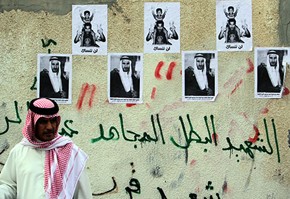
A Bahraini man passes images of Abdel Redha Buhameed in the western village of Malkiya this week. The words read: ?The martyr, the hero, the revolutionary: Abdel Redha,? beneath pictures of Buhameed, who died of injuries sustained last week when the army opened fire on protesters. AP Photo/ Hasan Jamali.
As much as anything, it's the complexity of the Middle East that's become more obvious over the past few weeks, writes Matthew Gray. If Niccolò Machiavelli were alive today, not only would he be in demand among the princes - and kings, presidents, and dictators - of the Middle East, but he would observe great differences how they conduct politics, why so many of them are resented, and the ways in which they have handled popular protests or the threat of them. Almost every leader in the Middle East has broken one of Machiavelli's golden rules: 'Government consists mainly in so keeping your subjects that they shall be neither able nor disposed to injure you.' What he meant here was that in an autocratic or similar system, an equilibrium is needed between coopting and repressing a population. A little of each, in balance, is an ideal method for ensuring the survival of a political order. If the balance is disturbed, however - if a regime is too brutal, or lets itself appear weak, or is not generous enough with welfare or oil money - then a leader's days, and even those of the regime or system more widely, are probably numbered. It had long been assumed that Middle Eastern leaders had this balance about right. For the past thirty or forty years they had been durable, though not very popular or legitimate in more recent times.
TO READ THIS ARTICLE, CREATE YOUR ACCOUNT
And extend your reading, free of charge and with no commitment.