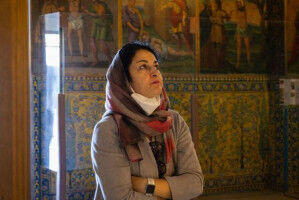
Diversity fellow focuses on changing meanings of peace
The search for peace is used as a means to defend the idea of war, vilify enemies or gain political points. But the concept of peace remains elusive. Political thinkers and philosophers have sought to defend and redefine it as early as the time of Plato, said Murad Idris, a postdoctoral associate in the government department and a Mellon Postdoctoral Diversity Fellow. "The claim that war is waged in order to attain peace appears as one of the central justifications for mass violence across the histories of political thought," said Idris at a March 8 campus lecture sponsored by the Judith Reppy Institute for Peace and Conflict Studies. "The claim that war is for the sake of peace is meaningful not because it's true or false, but because of what it covers up or masks, because it's so frequently repeated, and because it means different things across time, place, language and context." This year at Cornell, Idris is completing "Genealogies of Peace," a book that explores peace across the history of political thought. Idris argues that as an ideal, peace is embedded in cultural and political structures that reflect and facilitate antagonisms and anxieties. These anxieties are simultaneously about the fear of having become someone other than whom one claims to be, and about groups ambivalently included in peace, if at all - like the Persian for the Greek thinkers, the Turk for Renaissance Christians and the Muslim for Enlightenment secularists.