Starting in September this year, engineering students and companies will have the opportunity to enter into agreements on a new Industry Master of Science in Engineering model. The Ministry of Higher Education and Science has approved that all 32 of DTU’s master’s degree programmes can be studied under the so-called 1+2 Industry Master (MSc) model (see fact box), and DTU is ready to admit students in September 2026.
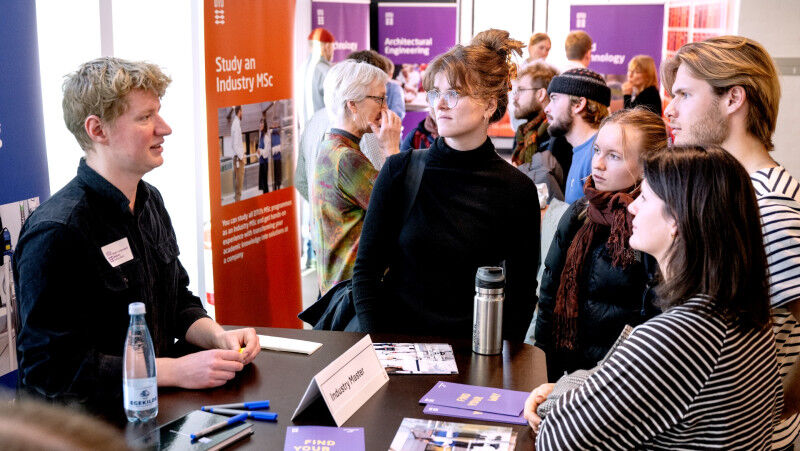
"At the recent master’s Information Day event, there was great interest in the Industry Master’s programmes among DTU students, and it is very positive that they now have access to the flexibility that the programmes offer. The 1+2 model in particular offers a powerful combination of academic learning and professional insight from a job, which many students are looking for," says Lars D. Christoffersen, Dean of Studies and Student Affairs at DTU.
The establishment of the 1+2 Industry Master’s model stems from the university reform, which was passed by a broad majority in the Danish Parliament in 2023. The reform was adopted with a political desire to change master’s programmes, increase flexibility, introduce more Industry Master’s programmes, and strengthen the link between the labor market and universities.
Denmark needs more engineers
Lars D. Christoffersen emphasizes that Industry Master’s programmes are an important tool for ensuring that Denmark does not lose the engineering talent that the business community and society so desperately need.He refers to the latest forecast from the consulting firms IRIS Group and HBS Economics, which concludes that by 2030, Denmark will be short of 13,000 trained graduates in the fields of engineering, technology, and IT.
The Danish Society of Engineers’ (IDA) projection (only i Danish) shows that there will be a growing imbalance towards 2040, when the demand for engineers and science graduates will exceed the number of graduates. The imbalance will increase from 7,700 in 2030 to 16,500 in 2035 and further to 20,400 in 2040.
"DTU is working hard to be allowed to educate more engineers. Therefore, the expansion of the Industry Master’s programmes is both a good offer and a necessity if we are to be able to contribute to growth, innovation, and green transition in companies throughout the country with our graduates," says Lars D. Christoffersen.
Employment of Industry Master graduates under the 1+2 model
The Industry Master of Science in Engineering programmes are offered at DTU in two different models.- The 1+2 model, where the student studies full-time in the first year and in the last two years is both a student and works a minimum of 25 hours per week in a company.
- The four-year model, where the student is both a student and works a minimum of 25 hours per week in a company for all four years.
In order to hire an Industry Master’s student, a company must be able to offer a study-relevant position with a minimum of 25 hours of work per week, spread throughout the year.
hiring Industry Master of Science in Engineering students from DTU.
Address Anker Engelunds Vej 101 2800 Kongens Lyngby CVR-nr. 30 06 09 46