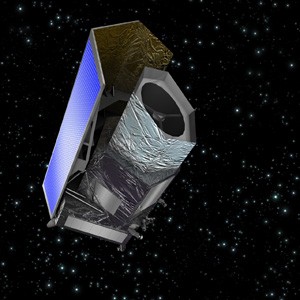
Artist’s impression of the Euclid satellite (Credit: ESA/C. Carreau)
The European Space Agency (ESA) today formally adopted the largest collaboration of astronomers in the World to help build the Euclid satellite, and UCL will be playing a major role. Adoption is the final phase to the selection of Euclid as part of ESA's Cosmic Vision programme and sets in motion an army of scientists and engineers to build and fly this new mission by the end of the decade. Euclid will study the "dark universe" with great precision, tracing the distribution and evolution of enigmatic dark matter and dark energy throughout the Universe. "This is the last big step to set the mission on its way", said Mark Cropper (UCL Mullard Space Science Laboratory), and lead of one of the two instruments on Euclid. "ESA and the Euclid Consortium have worked for over five years to get to this point against stiff competition for other mission proposals, and now we are formally adopted." ESA today endorsed a Multilateral Agreement between eleven European space agencies, NASA, and the Euclid Consortium, for the construction of key elements of the Euclid satellite, specifically the onboard instruments, software for analysing the data and the satellite's scientific leadership. Euclid will address issues at the foundations of physics, and will greatly increase our knowledge of how the Universe was formed and evolved. Ofer Lahav (UCL Physics & Astronomy) The Euclid Consortium will provide two instruments to ESA, a visible imaging instrument, named VIS, which is led from UCL's Mullard Space Science Laboratory, and a second near infrared imaging and spectrograph instrument.
TO READ THIS ARTICLE, CREATE YOUR ACCOUNT
And extend your reading, free of charge and with no commitment.