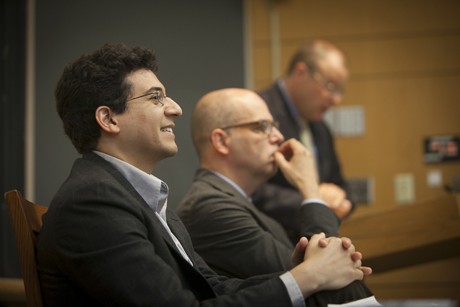
Jason Koski/University Photography
Although the world is safer today than it's ever been, the United States still faces major challenges in international relations, professors told alumni at the "America and the World" panel discussion June 7 during Reunion 2013. Excessive partisanship and bureaucratic fragmentation in Washington undermine policymaking and too often result in inconsistent responses to events around the world, they said. Nicolas van de Walle, the Maxwell M. Upson Professor of Government, and Aziz Rana, associate professor of law, joined moderator Fredrik Logevall, the John S. Knight Professor of International Studies and Cornell's vice provost for international relations, for a discussion of America's evolving economic and political relations with the rest of the world and the critical challenges facing President Barack Obama. "I'm not all that optimistic about major changes in the future," van de Walle said. "The Washington bureaucracy is an incredibly complicated Rube Goldberg contraption that is too fragmented and uncoordinated to consistently produce timely and proactive foreign policy." Causes of the fragmented system are myriad, van de Walle said, and include excessive partisanship, a weakened diplomatic corps, empowered special interests and the overarching influence of the military on foreign policy decisions. "Washington is suffering from interagency fragmentation and PADD, presidential attention deficit disorder," van de Walle said. Each cabinet level agency has its own foreign policy, the president's appointments are being shot down at unprecedented levels, and the president doesn't have time to deal with anything but the most pressing foreign policy issues, he said.
TO READ THIS ARTICLE, CREATE YOUR ACCOUNT
And extend your reading, free of charge and with no commitment.