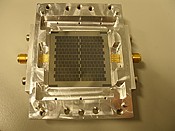
Prototype Kinetic Inductance Detector array manufactured at Cardiff University
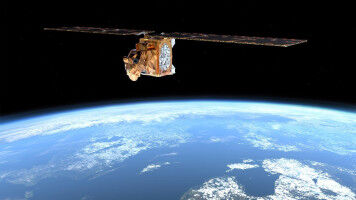
Cardiff University has launched the first ever Welsh-led European Union (EU) space research programme, funded by a €2M award from the EU through its FP7 (Framework Programme 7) SPACE programme. The three-year SPACEKIDS project will work to develop new detector technology for use in future space missions. The new detectors will be capable of working at extremely low temperatures and will be designed for use in future satellites for astronomy and for the study of the Earth's atmosphere. The project brings together some of the leading European institutes with expertise in detectors for far infrared wavelengths - a few hundred times longer than the wavelength of visible light. Current far infrared detectors being used on board spacecraft are very difficult to manufacture and operate. Research carried out by Cardiff's School of Physics and Astronomy to manufacture novel Kinetic Inductance Detectors (KIDs) offers a very real prospect of ultra-sensitive cameras which are easy to make and use. Project Coordinator, Professor Matt Griffin of Cardiff University's School of Physics and Astronomy, said: "SPACEKIDS is a fantastic initiative for Cardiff University and for space science and technology in Wales.
TO READ THIS ARTICLE, CREATE YOUR ACCOUNT
And extend your reading, free of charge and with no commitment.