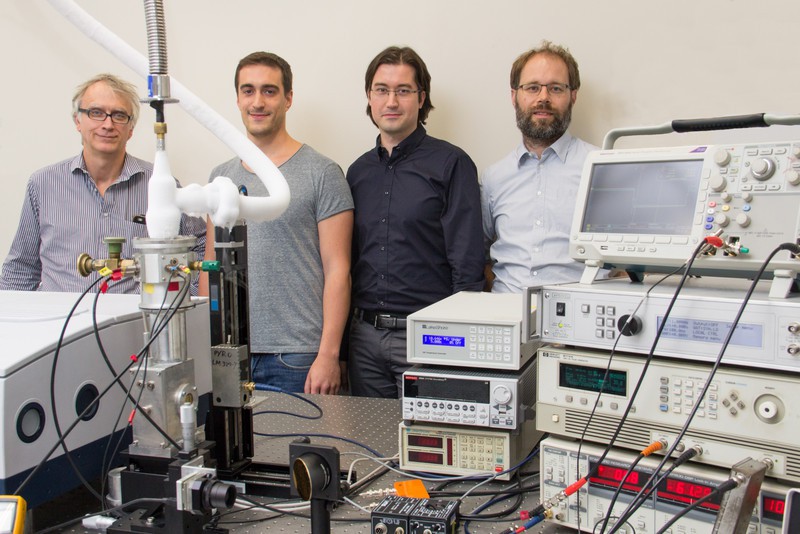
Karl Unterrainer, Sebastian Schönhuber, Michael Krall und Stefan Rotter (v.l.n.r.)
It was considered a practically unreachable goal: focused light in the Terahertz regime consisting of a broad spectrum of wavelengths. At TU Wien (Vienna) this feat has now been accomplished - using a surprising trick. Creating Terahertz radiation isn't easy, but it is extremely useful. It can, for example, be used for building chemical sensors to detect certain substances. For this purpose, however, the Terahertz light has to fulfil two important requirements: The light beam must be well focused, and in contrast to normal laser light, which has just one wavelength, it must have a broad spectrum of wavelengths. Combining these two seemingly conflicting requirements in one device has not been accomplished until now. Using an unusual trick, scientists at TU Wien (Vienna) have now presented a Terahertz laser with a well-focused beam and a broad spectrum: they created a laser with randomly located holes in the active laser medium.
TO READ THIS ARTICLE, CREATE YOUR ACCOUNT
And extend your reading, free of charge and with no commitment.