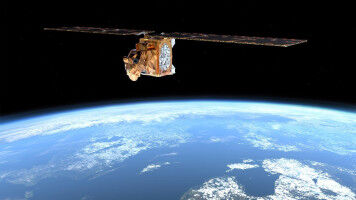
An image of continuous gravitational waves. Image by Mike Myers/ Swinburne University.
An image of continuous gravitational waves. Image by Mike Myers/ Swinburne University. The hunt for the never before heard "hum" of gravitational waves caused by mysterious neutron stars has just got a lot easier, thanks to an international team of researchers. Gravitational waves have only been detected from black holes and neutron stars colliding, major cosmic events that cause huge bursts that ripple through space and time. The research team, involving scientists from the LIGO Scientific Collaboration (LSC), Virgo Collaboration and the Centre for Gravitational Astrophysics (CGA) at The Australian National University (ANU), are now turning their eagle eye to spinning neutron stars to detect the waves. Unlike the massive bursts caused by black holes or neutron stars colliding, the researchers say single spinning neutron stars have a bulge or "mountain" only a few millimetres high, which may produce a steady constant stream or "hum" of gravitational waves. The researchers are using their methods that detected gravitational waves for the first time in 2015 to capture this steady soundtrack of the stars over the thunderous noise of massive black holes and dense neutron stars colliding.
TO READ THIS ARTICLE, CREATE YOUR ACCOUNT
And extend your reading, free of charge and with no commitment.