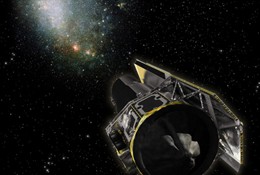
The ANU plasma thruster will help satellites travel for longer and further into deep space. Image courtesy of NASA.
Construction of a pioneering plasma thruster - an engine that could be used to power satellites to Mars - and a space simulation facility that will aid the development of the first Australian satellites is underway at Mt Stromlo Observatory. The project is being driven by the Space Plasma Power and Propulsion (SP3) Laboratory of the Research School of Physics and Engineering in close collaboration with the Research School of Astronomy and Astrophysics at The Australian National University. The plasma thruster and the space simulation facility are expected to be ready by mid-next year. The plasma thruster could be propelling a test satellite into space within the next two years. The initial missions will investigate the possibility of using the plasma thruster to send out-of-date satellites into 'graveyard' orbits. The long-term aim is to scale the prototypes up to allow flights to Mars. This would be the first time a satellite with a plasma engine has been tested.
TO READ THIS ARTICLE, CREATE YOUR ACCOUNT
And extend your reading, free of charge and with no commitment.