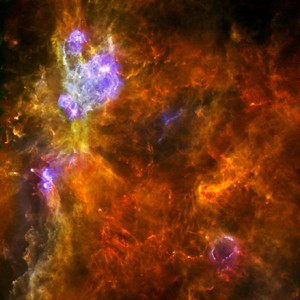
Hunting high-mass stars with Herschel. Credit: ESA/PACS & SPIRE consortia, A. Rivera-Ingraham & P.G. Martin, Univ. Toronto, HOBYS Key Programme (F. Motte)
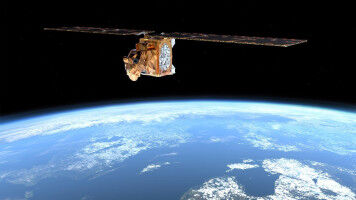
Europe's Herschel Space Observatory has exhausted its supply of liquid helium coolant, after almost four years of scientific observations. As none of the instruments can work without helium-cooling, Herschel's operational life is now over. The spacecraft itself will soon be placed in a parking orbit around the Sun, but the analysis and evaluation of the data will continue for years to come. Astronomers, including those at UCL's Mullard Space Science Laboratory (MSSL) and Department of Physics & Astronomy, have already made ground-breaking discoveries about the formation and evolution of stars, galaxies and planets using Herschel data. But this has only scratched the surface, and there is far more still to come from the immense archive. "The data from Herschel are mind-blowing," said Professor Mat Page, co-investigator on the SPIRE instrument from MSSL and lead author of a paper published in Nature which is based on SPIRE data. He added:"Herschel SPIRE's wavelength range was uncharted territory 5 years ago.
TO READ THIS ARTICLE, CREATE YOUR ACCOUNT
And extend your reading, free of charge and with no commitment.