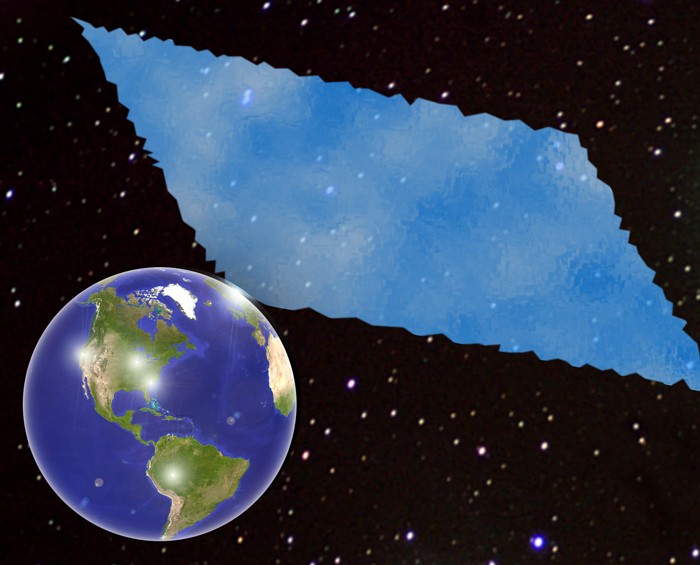
When Earth crosses a domain wall, the Global Network of Optical Magnetometers for Exotic Physics (GNOME) could detect the event using four magnetometers (Northern Hemisphere in this sketch) to determine the normal velocity of the wall and predict its passing at other locations. One or more remaining magnetometers would verify the prediction and the measurements.
Researchers from Canada, California, and Poland have devised a straightforward way to test an intriguing idea about the nature of dark energy and dark matter. A global array of atomic magnetometers - small laboratory devices that can sense minute changes in magnetic fields - could signal when Earth passes through fractures in space known as domain walls. These structures could be the answer to the universe's darkest mysteries. Dark energy opposes the mutual gravitational attraction of matter and causes the expansion of the universe to accelerate; it's thought to account for three-quarters of the universe's mass-energy. Another fifth is dark matter, sharing nothing with the remaining five percent of "ordinary" matter except gravitational attraction. There are plenty of theoretical ideas to explain dark matter and dark energy, but there's little experimental evidence to help scientists choose among them. An early candidate for both is a hypothetical particle called the axion.
TO READ THIS ARTICLE, CREATE YOUR ACCOUNT
And extend your reading, free of charge and with no commitment.