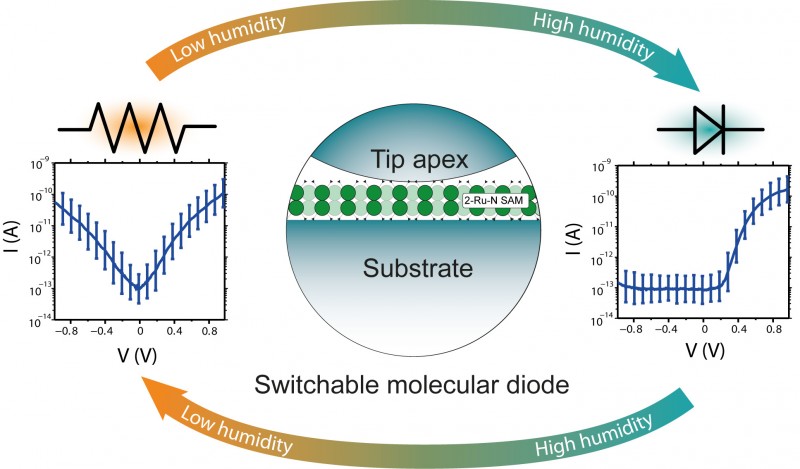
 At low humidity, the energy levels of the left and right side of the symmetric molecule are equal. At high humidity, the water resides on one side of the molecule. This is why the symmetry between the energy levels breaks already at zero voltage. At positive voltage, the energy levels get closer together, so a significant current can flow.
Molecular electronics is a growing research area where scientists study electrical properties of the molecules with a chemically programmed function. Molecules can function as diodes, switches and transistors, all with a typical length of few nanometers. An international group of scientists from University of Bern, Leiden University, Delft University of Technology, and Chuo University has developed the first switchable molecular diode. Diodes are basic electronic components which conduct electric current in a single direction. Researchers from the Department of Chemistry and Biochemistry of the University of Bern (Dr. Veerabhadrarao Kaliginedi, PD Dr. Peter Broekmann) and Leiden University (Prof. Sense Jan van der Molen's Group) together with colleagues from TU Delft (Prof. Joseph M. Thijssen's group), and Chuo University (Prof. Masa-aki Haga's group) have now demonstrated the first switchable molecular diode. This molecular diode can be turned on and off through humidity and vice versa it is a humidity sensor at nanoscale. The results now have been published in "Nature Nanotechnology".
TO READ THIS ARTICLE, CREATE YOUR ACCOUNT
And extend your reading, free of charge and with no commitment.
Your Benefits
- Access to all content
- Receive newsmails for news and jobs
- Post ads



