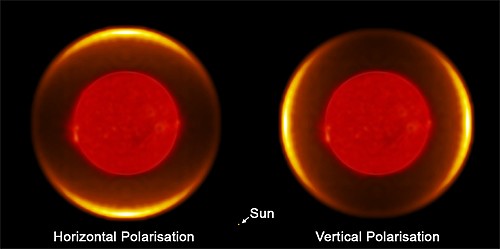
The winning entry ’Smoke and mirrors: a dusty halo discovered around red giant stars’, by PhD student Barnaby Norris.
A synthetic image produced from the data of the dust shell around the red giant star W Hydrae, has earned a team from the University of Sydney's Faculty of Science first prize in the annual Canon Australia's Extreme Imaging competition. PhD student, Barnaby Norris's entry 'Smoke and mirrors: a dusty halo discovered around red giant stars' shows two polarisations of light, horizontal and vertical. Norris says the image is equivalent to viewing the dust shell through polarised sunglasses. "At the end of their lives, stars make a grand exit as woollen red giants tens of thousands of times more luminous than our sun," he said. "They also drive strong stellar winds into deep space, enriching the galaxy with elements essential for life." How this wind is launched had been a long-running astronomical enigma until Norris and a research team lead by Associate Peter Tuthill from the School of Physics , pioneered a new imaging technique that can detect very faint light scattered from dust. "The project is possibly the biggest finding to-date around the long-running mystery of the origin of the red giant winds," said Tuthill, who is Norris's PhD supervisor. Also receiving a highly commend award was an image titled 'Drone versus Swarm' submitted by Faculty of Engineering and Information Technologies PhD student Tariq Abuhashim.
TO READ THIS ARTICLE, CREATE YOUR ACCOUNT
And extend your reading, free of charge and with no commitment.