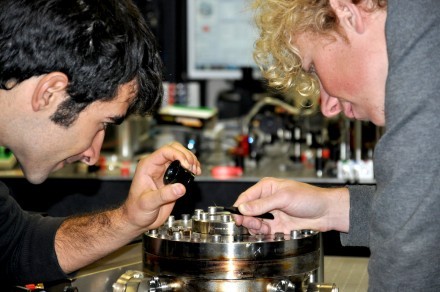
PhD students Giovanni Guccione (L) and Harry Slatyer examine their gold-coated silver gallium nanowire in the Quantum Optics labs. Image: Quantum Optics Group, ANU
Laser physicists have found a way to make atomic-force microscope probes 20 times more sensitive and capable of detecting forces as small as the weight of an individual virus. The technique, developed by researchers in the Quantum Optics Group of the Research School of Physics and Engineering, hinges on using laser beams to cool a nanowire probe to minus 265 degrees Celsius. "The level of sensitivity achieved after cooling is accurate enough for us to sense the weight of a large virus that is 100 billion times lighter than a mosquito," said Dr Ben Buchler. The development could be used to improve the resolution of atomic-force microscopes, which are the state-of-the-art tool for measuring nanoscopic structures and the tiny forces between molecules. Atomic force microscopes achieve extraordinarily sensitivity measurements of microscopic features by scanning a wire probe over a surface. However, the probes, around 500 times finer than a human hair, are prone to vibration. "At room temperature the probe vibrates, just because it is warm, and this can make your measurements noisy," said Professor Ping Koy Lam, a co-author of the research that is published.
TO READ THIS ARTICLE, CREATE YOUR ACCOUNT
And extend your reading, free of charge and with no commitment.