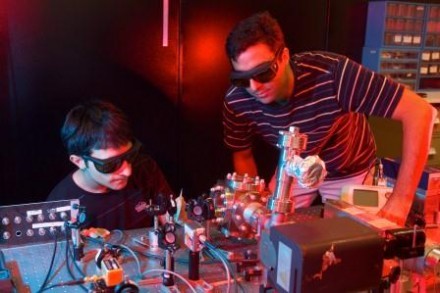
Dr Mahdi Hosseini and Mr Giovanni Guccione working on their opto-mechanical laser system
Physicists from The Australian National University have shown that three lasers are better than one when it comes to levitating small but visible objects on light, designing an extremely precise sensor by floating a mirror on a tripod of lasers. "Levitation itself is not new," says Professor Ping Koy Lam from the ANU Department of Quantum Science. "But our ability to measure gravitational force using a levitating mirror as a sensor is new." Professor Lam and his team have shown it is possible to stably suspend a mirror using three laser beams and collect the reflected light. "Imagine you've got something above you and you are throwing ping pong balls at it to keep it in the air," says Dr Ben Buchler. "Levitating using lasers works in a similar way, but the ping pong balls are light particles being fired at the mirror." "Most of the light in other laser levitation systems is scattered, but since we are levitating a mirror we are reflecting that light back and we can retrieve the information from it," says Mr Giovanni Guccione. Levitating a convex mirror, as opposed to a micro particle allows the physicists to measure any movement in the mirror. "You can measure the position of the mirror very precisely because you are using a laser to do the measurement," says Dr Mahdi Hosseini.
TO READ THIS ARTICLE, CREATE YOUR ACCOUNT
And extend your reading, free of charge and with no commitment.