Dating is really hard - especially in the countryside. You already know everyone your age in the village and have already swiped through all the dating apps. If you don’t want to live alone, you have to look for a partner somewhere. But where? And how are you supposed to get to your date when the last bus of the day has long since left the village? The new podcast series "Live Love Land" answers these and other questions that concern young singles in Central Germany. The series was produced by Leipzig University’s Master’s degree program in Journalism in cooperation with MDR WISSEN and is now available.
The podcast can be found on the MDR website. The journalism students delved deep into the topic and set out to find two young singles who would like to be sent on a blind date. "Just like finding a real partner, it wasn’t that easy," says Hanna Rieger, a student on the Master’s degree course in Journalism. "In the beginning, we tried to use Tinder and Instagram to find young people who wanted to take part in the podcast. But because that wasn’t successful, we ended up looking at Christmas markets and sports clubs all over central Germany out of desperation. In the end, we found Emily and Olli, who are a ’perfect match’."
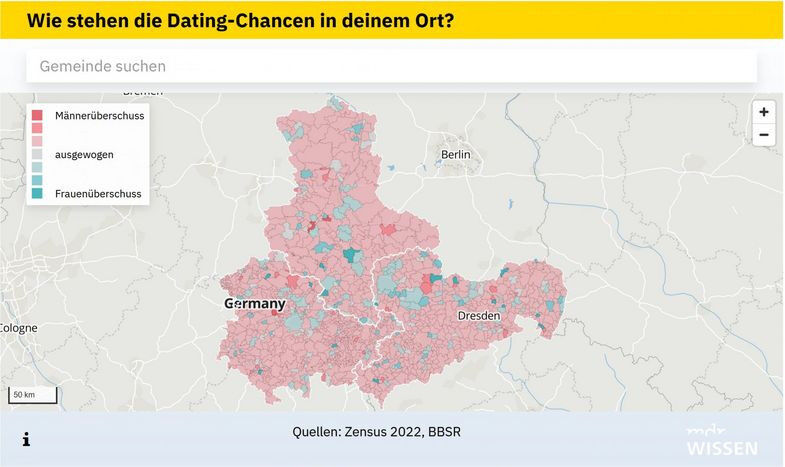
In the end, a three-part podcast series and a website with an interactive data tool were created for the target group of 20 to 30-year-olds. In the podcast, you can experience the story of Emily and Olli up close - from the first meeting to the first date to the question of what happens next with the two of them. Experts on the topics of demographics, infrastructure and psychology, together with student presenter Therese Werner, scientifically classify the couple’s experiences. The facts are illustrated in the data tool with the help of interactive maps.
"Our students have tracked down a topic that is more socially relevant than it might seem at first glance. They have examined it from all angles and analyzed the data," says course director Markus Beiler. Gerald Perschke from MDR WISSEN says: "Love in the countryside - without it sounding like ’farmer looking for a wife’. The team has succeeded wonderfully in combining a very personal approach with science that tells us something about the future of life beyond the cities."
The episodes
Episode 1: "Matchmaking". Footballer Olli and handball player Emily are introduced in their respective homes. They talk about their everyday lives and how they imagine their dream partner. This episode includes expert knowledge from Henrik-Alexander Schubert from the Max Planck Institute for Demographic Research. He talks about gender distribution in rural areas and the migration of young people. In the data tool, users can look up the statistical dating chances in their home town.
Episode 2: "The tension is rising: The first date". Emily and Olli prepare for their first date. What do they wear? What impression do they want to make on the other person? Finally, we listen in on the date in a café in Bad Düben. The expert for this episode is Dr. Ralph Richter from the Leibniz Institute for Spatial Social Research. He knows where you can meet up for a date even if the last village pub closed years ago. His scientific focus is on mobility and infrastructure in rural areas.
Episode 3: "A rosy future: what’s next?" Emily and Olli continue to be accompanied. Will they have a second date? When will they tell acquaintances and family to get ahead of the rumor mill? Where else could they meet someone - even far away from dating apps? The expert for this episode, psychologist Anja Wermann, explains psychological phenomena such as "attachment styles", changes in dating behavior due to dating apps and forms of relationships.
The project participants
The students involved in the project were Johanna Bernklau, Ella Gößelein, Max Greger, Gyde Hansen, Alina Haynert, Jakob Kluck, Melissa Nüssle, Friederike Pick, Hanna Rieger, Lea Schön, Tabea Volz, Therese Werner and Lina Wölfel - under the supervision of Gerald Perschke (MDR Wissen) as well as Maria Hendrischke and Uwe Krüger (Leipzig University).
In the Master’s degree course in Journalism, students learn how to accompany and innovatively shape the digital transformation of journalism. To this end, the course combines in-depth journalistic training with IT skills and knowledge of applied social and journalism research. The three-year course includes a traineeship. More information can be found online.