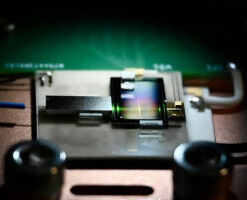
LOFAR tunes in to pulsars
It's here that an international team, including Oxford University scientists, are building an array that, linked up with stations in the Netherlands, Germany, and France will form LOFAR , one of the world's most powerful radio telescopes. I asked LOFAR scientist Aris Karastergiou of Oxford's Department of Physics about the new telescope, the search for pulsars, and how games console hardware could help decode their enigmatic signals. OxSciBlog: What makes pulsars so challenging to study? - Aris Karastergiou: In a sense it is amazing that we can study pulsars at all, as they are compact objects around 10-20 km in diameter. However, they emit very bright beams of light (in the radio frequencies) from their two magnetic poles, which sweep through space as the pulsar rotates. If Earth happens to be in the path of these sweeping beams of a pulsar, we can point a radio telescope towards it and collect this light. Even then, however, the fact that the most scientifically interesting pulsars rotate over 100 times a second means that observations require not only high sensitivity but also very fast recorders, capable of sampling the incoming light at extremely short intervals. The fact that pulsar light travels through the Galaxy before reaching us adds further challenges to pulsar studies, as radio waves interact with electrons in the medium between the stars.