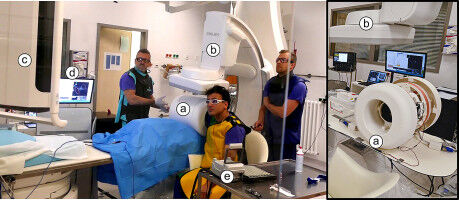
Researchers from the University of Stuttgart for the first time put the innovative helicon-based inductive plasma thruster (IPT) into operation [Picture: Universität Stuttgart / IRS]
Researchers from the University of Stuttgart for the first time put the innovative helicon-based inductive plasma thruster (IPT) into operation [ Picture: Universität Stuttgart / IRS] Earth observation satellites for very low altitudes, smaller, lighter, and cheaper than conventional models: These are the goals of the EU project "DISCOVERER", in which nine partners from Europe and the US are involved. For the first time, the new inductive plasma thruster (IPT) was ignited at the Institute of Space Systems (IRS) of the University of Stuttgart. The novel plasma thruster is intended to solve one of the key problems of the mission: It compensates the aerodynamic drag in very low orbits, thereby extending the satellites' lifetime. The thruster is based on helicon waves and it is equipped with an antenna used in the medical field. Satellite missions in the so-called "Very Low Earth Orbit", i.e. at low altitudes of up to 400 km, enable new methods of Earth observation, such as the permanent measurement of the Earth's gravity field using small and inexpensive satellites. However, there is still a relatively high aerodynamic drag at these altitudes due to the residual atmosphere. Because of the aerodynamic drag, the satellite gets slower over time, which allows gravity to draw it closer to the Earth until it enters the Earth's atmosphere and demises.
TO READ THIS ARTICLE, CREATE YOUR ACCOUNT
And extend your reading, free of charge and with no commitment.