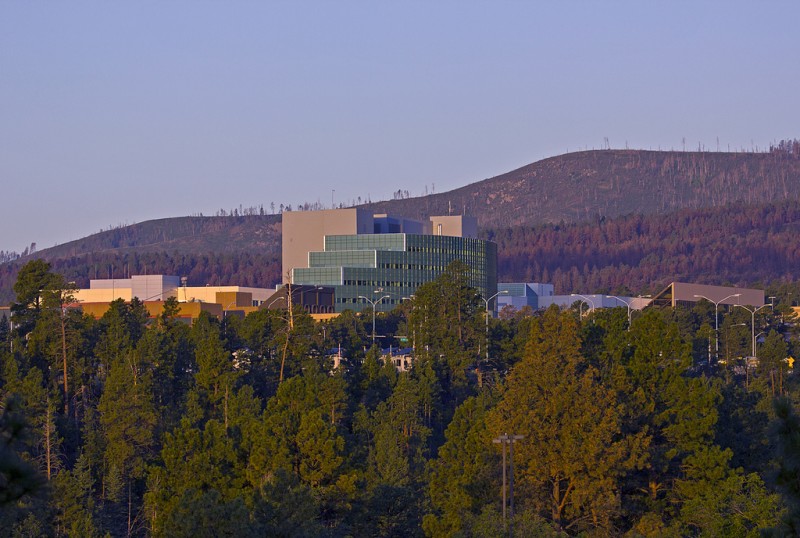
Los Alamos National Laboratory sits on top of a once-remote mesa in northern New Mexico with the Jemez mountains as a backdrop to research and innovation covering multi-disciplines from bioscience, sustainable energy sources, to plasma physics and new materials.
The robust ChemCam system is one of 10 instruments mounted on the mission's rover vehicle, named Curiosity. LANL ChemCam will help unravel mysteries of Red Planet's composition LOS ALAMOS, New Mexico, November 28, 2011—With the successful launch of the Mars Science Laboratory on Saturday, Los Alamos National Laboratory researchers and scientists from the French space institute IRAP are poised to begin focusing the energy of a million light bulbs on the surface of the Red Planet to help determine whether Mars was or is habitable. The international team of space explorers that launched the Mars Science Laboratory last week is relying in part on an instrument originally developed at Los Alamos called ChemCam, which will use blasts of laser energy to remotely probe Mars's surface. The robust ChemCam system is one of 10 instruments mounted on the mission's rover vehicle, named Curiosity. When ChemCam fires its extremely powerful laser pulse, it will vaporize an area the size of a pinhead. The system's telescope will peer at the flash of glowing plasma created by the vaporized material and record the colors of light contained within it. These spectral colors will then be interpreted by a spectrometer, enabling scientists to determine the elemental composition of the vaporized material.
TO READ THIS ARTICLE, CREATE YOUR ACCOUNT
And extend your reading, free of charge and with no commitment.