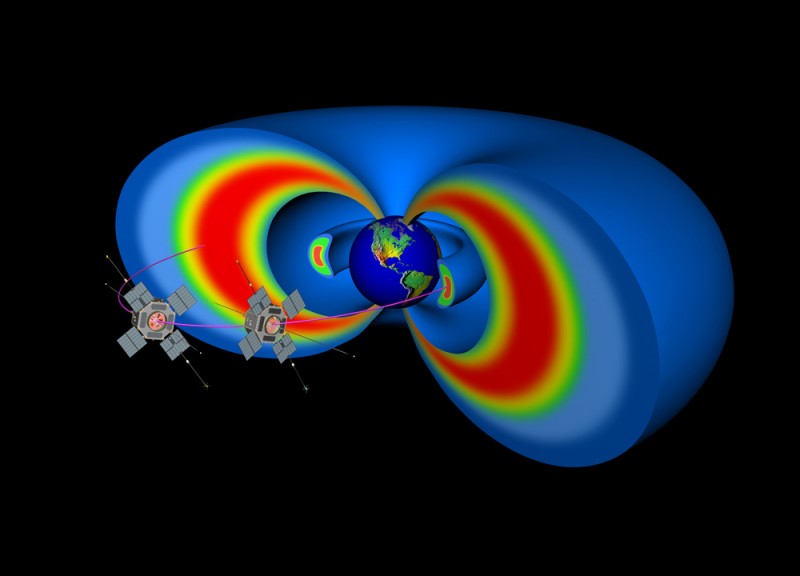
Artist’s rendering showing two spacecraft representing the not-yet-designed Radiation Belt Storm Probes that will study the sun and its effects on Earth. PHOTO CREDIT: Johns Hopkins University Applied Physics Laboratory
The HOPE analyzer is one of a suite of instruments that was successfully launched as part of the Radiation Belt Storm Probe mission. Spacecraft pair to explore mysterious region where other satellites fear to tread LOS ALAMOS, NEW MEXICO, August 30,2012—Los Alamos National Laboratory expertise in radiation detection and shielding is poised to help a national team of scientists better understand a mysterious region that can create hazardous space weather near our home planet. The Helium Oxygen Proton Electron (HOPE) analyzer is one of a suite of instruments that was successfully launched today as part of the Radiation Belt Storm Probe mission—an effort by NASA and the Johns Hopkins University's Applied Physics Laboratory to gain insight into the Sun's influence on Earth and near-Earth space by studying our planet's radiation belt. The radiation belt—also known as the Van Allen belt in honor of its discoverer, James Van Allen—is a donut shaped soup of charged particles that surrounds Earth and occupies the inner region of our planet's Magnetosphere. The outer region of the belt is comprised of extremely high-energy electrons, a shower of tiny, negatively charged bullets if you will, that can easily pierce the skin of spacecraft and knock out their electrical components. Because of these hazards, spacecraft routinely avoid the region. "Today we are boldly going where no spacecraft ever wants to go,” said plasma physicist Geoffrey Reeves of Los Alamos National Laboratory's Intelligence and Space Research Division.
TO READ THIS ARTICLE, CREATE YOUR ACCOUNT
And extend your reading, free of charge and with no commitment.