Robert Barker/University Photography
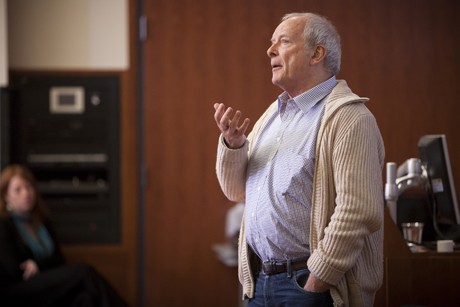
Understanding the musicality of the past can enrich the musical life of the present, said Christopher Hogwood Oct. 25 in his first visit to campus as an A.D. White Professor-at-Large in a talk titled "The Past Is a Foreign Country: Why Making Music Matters." "To help in that thesis, I would call upon the fact that now for the first time we are really the first group of people who can draw on more than a century's worth of recorded evidence of how music was heard in the past," said Hogwood, a conductor, musicologist and musician. Hogwood, a professor of music at Gresham College, London, and emeritus honorary professor of music at the University of Cambridge, said such a wealth of recordings will allow people to pursue a historical interest in music, and that music of the 19th and 20th centuries can be observed and judged by everyone, not just expert musicians or historians. He likened musical study to that of classics: "Classics has gone the same way. Classics in translation is now acceptable academic study. You do not have to necessarily read the Greek alphabet to talk knowingly about Homer." Hogwood warned that when listening to early musical recordings one must be careful. "The idea that music is like a Darwinian progression where each generation gets better and better has long been given up," he said.
TO READ THIS ARTICLE, CREATE YOUR ACCOUNT
And extend your reading, free of charge and with no commitment.