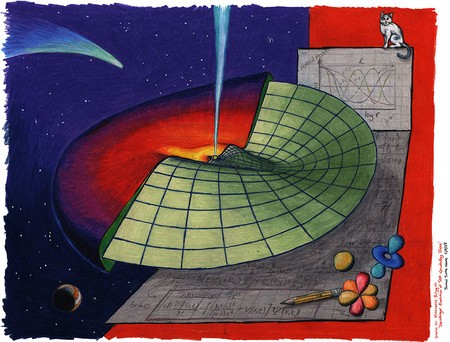
Schrödinger in Space: An artist’s impression of research presented in Batygin (2018), MNRAS 475, 4. Propagation of waves through an astrophysical disk can be understood using Schrödinger’s equation - a cornerstone of quantum mechanics.
Quantum mechanics is the branch of physics governing the sometimes-strange behavior of the tiny particles that make up our universe. Equations describing the quantum world are generally confined to the subatomic realm-the mathematics relevant at very small scales is not relevant at larger scales, and vice versa. However, a surprising new discovery from a Caltech researcher suggests that the Schrödinger Equation-the fundamental equation of quantum mechanics-is remarkably useful in describing the long-term evolution of certain astronomical structures. The work, done by Konstantin Batygin (MS '10, PhD '12), a Caltech assistant professor of planetary science and Van Nuys Page Scholar, is described in a paper appearing in the March 5 issue of Monthly Notices of the Royal Astronomical Society . Massive astronomical objects are frequently encircled by groups of smaller objects that revolve around them, like the planets around the sun. For example, supermassive black holes are orbited by swarms of stars, which are themselves orbited by enormous amounts of rock, ice, and other space debris. Due to gravitational forces, these huge volumes of material form into flat, round disks.
TO READ THIS ARTICLE, CREATE YOUR ACCOUNT
And extend your reading, free of charge and with no commitment.