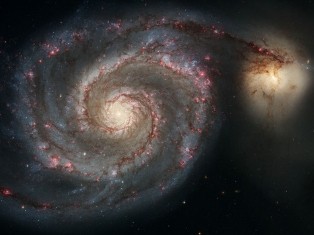
Hubble Space Telescope image representing a merger between two galaxies similar in mass to the Milky Way and the Large Magellanic Cloud. Credit: NASA, ESA, S. Beckwith (STScI), and The Hubble Heritage Team (STScI/AURA)
The Milky Way is on a collision course with a neighbouring galaxy that could fling our Solar System into space. The Large Magellanic Cloud could hit our galaxy in two billion years' time This galactic collision would happen much sooner than the predicted impact between the Milky Way and another neighbour, Andromeda, which scientists say will hit our galaxy in eight billion years. Active black hole The coming together with the Large Magellanic Cloud could wake up our galaxy's dormant black hole, which would begin devouring surrounding gas and increase in size by up to ten times. As it feeds, the now-active black hole would throw out high-energy radiation. While these cosmic fireworks are unlikely to affect life on Earth, researchers say there is a small chance that the initial collision could send our Solar System hurtling into space. Dark matter The Large Magellanic Cloud is the Milky Way's brightest satellite galaxy and only entered our neighbourhood about 1.5 billion years ago. It sits about 163,000 light years from our galaxy.
TO READ THIS ARTICLE, CREATE YOUR ACCOUNT
And extend your reading, free of charge and with no commitment.