Chemists from the Massachusetts Institute of Technology (MIT) and physicists from the University of Stuttgart are working together to develop new models to describe electrochemically controlled molecular self-organization. The German-American project is funded by the MIT Global Seed Fund.
Molecules constantly interact with each other and can thus arrange themselves independently into ordered structures. "For example, to form whipped cream," says Thomas Speck, Head of the Institute for Theoretical Physics IV. "Air bubbles form when whipping cream. Through molecular self-organization, fat and protein molecules form a network around these air bubbles. A foam structure is created." Whipped cream is of course just one of countless examples, says Speck. "Molecular self-organization is one of the fundamental organizing principles of nature and is also behind highly complex structures such as the human body."
"The better we understand molecular self-organization, the more likely it is that we will one day be able to actively control the process and use it to develop new technologies," says Speck. The chemical and physical properties of molecules are responsible for molecular self-organization. However, there are still many unanswered questions about what triggers the process and how it works in detail.
This is where a joint project between the Massachusetts Institute of Technology (MIT) and the University of Stuttgart comes in. Since May 2025, the Institute for Theoretical Physics IV has been working together with chemists from MIT on new methods and models that should help to gain a better understanding of molecular self-organization.
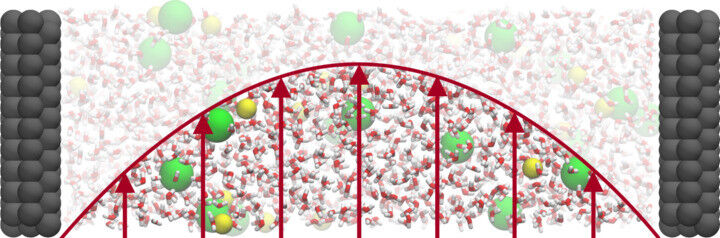
Specifically, the researchers are taking a closer look at electrochemical processes, i.e. processes that are triggered by electrical voltages or changes in charge. Electrochemically controlled molecular self-organization plays a central role in the operation of batteries, among other things. "Our basic research could form a basis for the development of new supercapacitors, which would speed up the charging of battery vehicles enormously, for example," says Speck.
The cooperation was initiated by MIT: "Professor Adam Willard, whom I know personally from my postdoc days, approached me. He conducts research at MIT on the organization of ions and the structure of electrolytes using computer simulations. Here at the Institute for Theoretical Physics IV, we use theoretical methods of statistical non-equilibrium physics to explain dynamic phenomena. By combining both areas of expertise, we gain new insights."
The German-American project is made possible by the MIT Global Seed Fund. The aim of the fund is to deepen the relationship between MIT and the University of Stuttgart through joint projects and to identify and utilize synergies. The fund provides up to 25,000 dollars in start-up financing per project. "We can use the funds to finance research trips to the USA and Germany. This enables a particularly intensive exchange and gives the collaboration a valuable boost," says Thomas Speck. "For the young scientists involved, the research visits are also a good opportunity for professional and personal development."
In addition to Willard and Speck, the direct project team includes a doctoral student from MIT and a doctoral student from Stuttgart. Other researchers will also be involved. The project is scheduled to run for one and a half years, during which time a joint workshop is planned for both research groups in Stuttgart, which will provide plenty of space for professional exchange and the development of joint ideas.