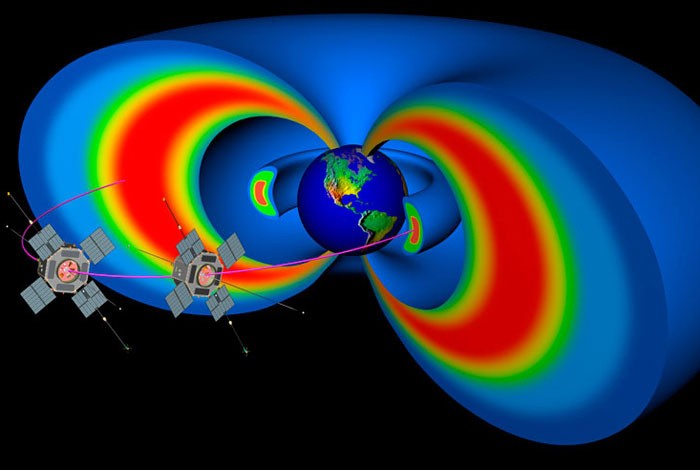
This NASA rendering depicts Earth’s Van Allen radiation belts and the path of the Van Allen Probe spacecraft, which were launched in August 2012. Data from the spacecraft have confirmed a never-before-seen phenomenon--a long-lived zone of high-energy electrons residing between the inner and outer radiation belts. (Credit: NASA illustration)
The belts are a pair of donut shaped zones of charged particles that surround Earth and occupy the inner region of our planet's Magnetosphere. As the mission proceeds, we expect further surprises that will challenge our conventional wisdom on the transport, loss and energization processes in these highly energetic electron radiation regions. Instruments detect never-before-seen phenomenon in Earth's Magnetosphere. LOS ALAMOS, N.M. March 1, 2013—U.S. researchers, including a trio from Los Alamos National Laboratory, have witnessed the mysterious appearance of a relatively long-lived zone of high-energy electrons stored between Earth's Van Allen radiation belts. The surprising findings, discovered by NASA's Van Allen Probes (formerly known as the Radiation Belt Storm Probes), were outlined Thursday in Science Express and during a press conference at NASA headquarters in Washington, D.C. The research was led by Dan Baker of the University of Colorado, Boulder, Laboratory for Atmospheric and Space Physics. "Nature keeps on surprising us by producing long-lived harsh environments in space in regions not previously considered,” said Los Alamos plasma physicist Reiner Friedel of LANL's Intelligence and Space Research Division.
TO READ THIS ARTICLE, CREATE YOUR ACCOUNT
And extend your reading, free of charge and with no commitment.