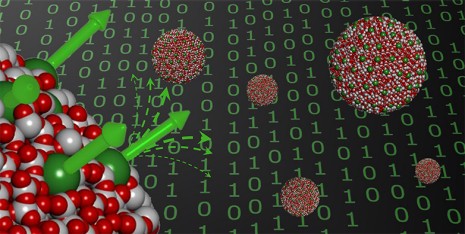
Dysprosium atoms (green) on the surface of nanoparticles can be magnetised in only one of two possible directions: ‘spin up’ or ‘spin down’. (Visualisations: ETH Zurich / Université de Rennes)
An international team of researchers led by chemists from ETH Zurich have developed a method for depositing single magnetisable atoms onto a surface. This is especially interesting for the development of new miniature data storage devices. The idea is intriguing: if only a single atom or small molecule was needed for a single unit of data (a zero or a one in the case of binary digital technology), massive volumes of data could be stored in the tiniest amount of space. This is theoretically possible, because certain atoms can be magnetised in only one of two possible directions: 'spin up' or 'spin down'. Information could then be stored and read by the sequence of the molecules' magnetisation directions. However, several obstacles still need to be overcome before single-molecule magnet data storage becomes a reality. Finding molecules that can store the magnetic information permanently and not just fleetingly is a challenge, and it is even more difficult to arrange these molecules on a solid surface to build data storage carriers.
TO READ THIS ARTICLE, CREATE YOUR ACCOUNT
And extend your reading, free of charge and with no commitment.