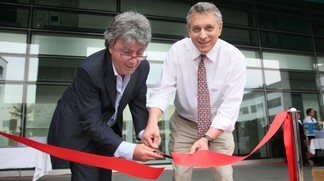
The BM building was inaugurated Tuesday by EPFL President Patrick Aebischer and the dean of STI, Demetri Psaltis
Renovated from top to bottom, EPFL's microengineering building is now prepared to house new, highly promising experiments in microengineering and bioengineering. A complex of exceptional cleanrooms - unique in Switzerland - is now available for scientists, students and research partners. EPFL has proven once again that it will put all its cards on the table to position itself among the world's top science and technology institutes. At a time when the rise of micro- and nano-technology is strongly influencing the traditional engineering disciplines, the Lausanne-based School has invested 14.4 million Swiss francs to renovate and transform its microengineering building. Inaugurated on Tuesday, the building can now meet the needs of new professors that have been recently recruited to the Engineering School (STI), as well as all scientists who are using the latest nanofabrication techniques. It houses a new complex of cleanrooms, new faculty offices and twelve new laboratories in which research runs the gamut - from measuring the mechanical properties of nanotubes or the dynamics of fluids, to studying optical neuron networks. A tailor-made building - In addition to the microengineering building on the Lausanne campus, EPFL has other sites dedicated to nanotechnology: the Interdisciplinary Center of Electron Microscopy (CIME), and the Comlab in Neuchâtel, which is part of the Swiss Center for Electronics and Microtechnology (CSEM).
TO READ THIS ARTICLE, CREATE YOUR ACCOUNT
And extend your reading, free of charge and with no commitment.