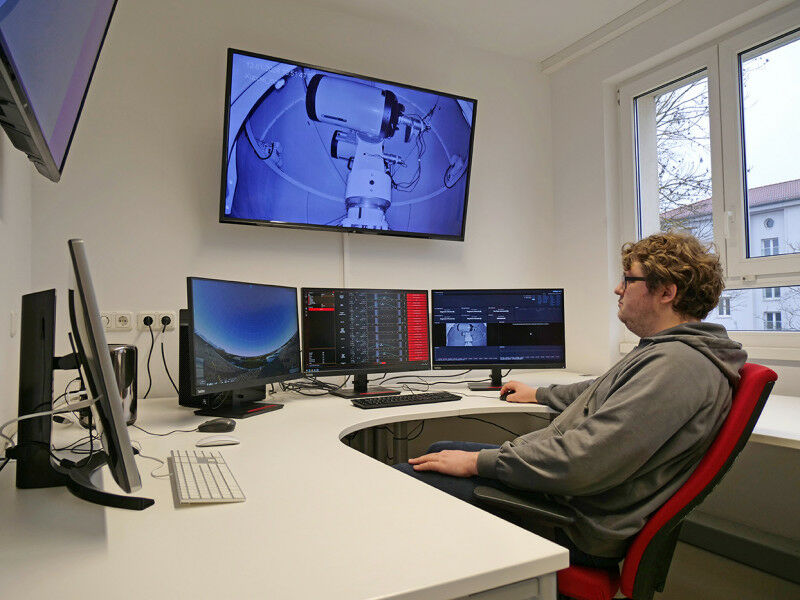
Julius Dill, a Würzburg student of aerospace informatics, works on the remote control of the new telescope in the mission control centre at the Hubland Campus. (Image: Robert Emmerich / Universität Würzburg)
Julius Dill, a Würzburg student of aerospace informatics, works on the remote control of the new telescope in the mission control centre at the Hubland Campus. (Image: Robert Emmerich / Universität Würzburg) A dome around three metres high sits enthroned on the roof of the Geography building on the Würzburg Hubland Campus. It contains a telescope that students are using to develop an intelligent sensor for satellites. A new telescope has been in operation on the Hubland Campus of Julius-Maximilians-Universität (JMU) Würzburg since January 2024. A team of students is using it to develop AI algorithms for small satellites in order to prevent collisions with space debris in orbit more efficiently than before. The long-term goal is for the satellites to be able to recognise impending collisions independently using intelligent optical sensors and avoid them autonomously. The Federal Ministry for Economic Affairs and Energy is funding the KI-SENS project with a good 500,000 euros.
TO READ THIS ARTICLE, CREATE YOUR ACCOUNT
And extend your reading, free of charge and with no commitment.