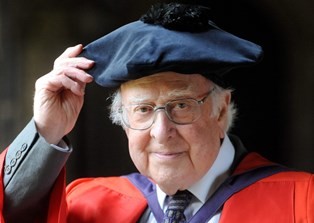
Prof Peter Higgs receives honorary degree
We use cookies to ensure that we give you the best experience on our website. You can change your cookie settings at any time. Otherwise, we'll assume you're OK to continue. Nobel Prize in Physics a "truly fundamental conceptual achievement” The award of the Nobel Prize in Physics to the men behind the Higgs boson "recognises a truly fundamental conceptual achievement in particle physics", according to a Durham University expert. Professor Valentin Khoze, Director of Durham's Institute for Particle Physics Phenomenology (IPPP), was commenting after Professor Peter Higgs, from the UK, and Professor Francois Englert, from Belgium, were awarded the prize. The pioneering work of Higgs and Englert laid down theoretical foundations for the electro-weak symmetry breaking - the concept which is at the heart of contemporary particle physics. Fifty years ago they predicted that a particle - the Higgs boson - that generated masses for other elementary particles must exist in nature. Last year scientists at the Large Hadron Collider (LHC) at CERN, in Geneva, announced they had found the long-sought Higgs boson.
TO READ THIS ARTICLE, CREATE YOUR ACCOUNT
And extend your reading, free of charge and with no commitment.