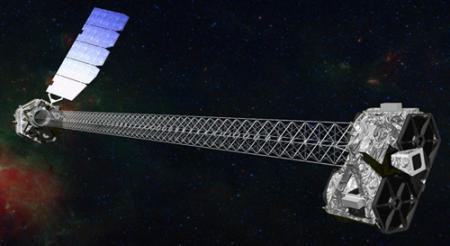
Artist's concept of NuSTAR in orbit.
This morning, NASA's NuSTAR telescope was launched into the low-Earth orbit from which it will begin exploring the high-energy X-ray universe to uncover the secrets of black holes, the dense remnants of dead stars, energetic cosmic explosions, and even our very own sun. The space telescope-the most powerful high-energy X-ray telescope ever developed-rode toward its destination inside the nose of a Pegasus rocket strapped onto the belly of a "Stargazer" L-1011 aircraft. Around 9:00 a.m. (PDT), the plane-which had earlier taken off from the Kwajalein Atoll in the western Pacific-dropped the rocket from an altitude of 39,000 feet. The rocket was in free fall for about five seconds before the first of its three stages ignited, blasting NuSTAR into orbit around the equator. "NuSTAR will open a whole new window on the universe by being the very first telescope to focus high-energy X rays," says Fiona Harrison, professor of physics and astronomy at Caltech and the principal investigator of the NuSTAR mission. The telescope is 100 times more sensitive than any previous high-energy X-ray telescope, and it will make images that are 10 times sharper than any that have been taken before at these energies, she says. NuSTAR-short for "Nuclear Spectroscopic Telescope Array"-can make sensitive observations of cosmic phenomena at higher frequencies than other X-ray telescopes now in orbit, including NASA's Chandra X-Ray Observatory and the European Space Agency's XMM-Newton observatory.
TO READ THIS ARTICLE, CREATE YOUR ACCOUNT
And extend your reading, free of charge and with no commitment.