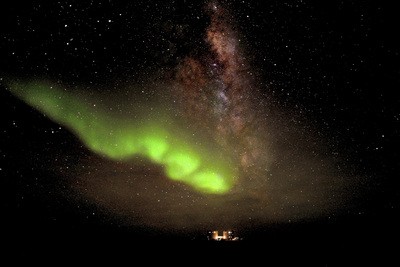
Aurora over the south pole
Set against a star-studded backdrop and a splash of the Milky Way, the green glow of an auroral curtain pervades the permanently dark winter skies of the South Pole. The only sign of life here is the Concordia research station that ESA uses to prepare for future long-duration missions beyond Earth. The site also caters to scientific research from geology and glaciology to climate change, astronomy and planetary magnetic fields. Even though the Sun barely peeks above the horizon for months on end, its effects are still played out with the fleeting visit of the aurora australis, or southern lights (at the North Pole they are known as aurora borealis, or the northern lights). These colourful displays are produced when electrically charged particles travelling from the Sun in the solar wind are channelled along Earth's magnetic field lines and strike atoms high in the atmosphere. The colours correspond to collisions with different gases in the atmosphere at different altitudes. Collisions with oxygen atoms typically generate green aurora, while nitrogen lights up the sky in red.
TO READ THIS ARTICLE, CREATE YOUR ACCOUNT
And extend your reading, free of charge and with no commitment.