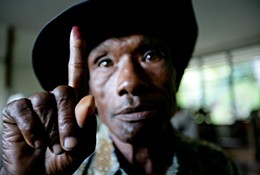
A man demonstrates the ink on his finger, confirming his early-morning vote in Timor-Leste's parliamentary elections. Photo by UN Photo/Martine Perret unmultimedia.org/photo/
A loose coalition of up to four political parties, or 'rainbow alliance', is the most likely result of Timor-Leste's recent parliamentary elections, write SUE INGRAM and ARMINDO MAIA. Timor's Partido Democratico (PD) may well be the kingmaker following last Saturday's Parliamentary election. Despite a large field of 21 parties, the preliminary results indicate that only four parties have achieved the three per cent threshold required to secure a place in Timor's Parliament, which is elected from a single national constituency. Under Timor's constitution, the President is guided by the Parliament in his nomination of the Prime Minister, which in effect means that the party or alliance of parties with a majority of seats determines who will be appointed. Of the four parties which, based on the preliminary results, will have seats in the 65 seat Parliament, CNRT could expect 30 seats, trumping its arch rival FRETILIN at 25, while PD could expect eight seats and a new party, Frente-Mudanca, two. CNRT, led by outgoing Prime Minister Xanana Gusmao, has massively improved its vote share over the previous election in 2007 (36.7 per cent compared to 24.1 per cent in 2007) and come much closer to the overall majority it hoped for. But coming close is not enough, and it will need to enter into an alliance with another party or parties to form government.
TO READ THIS ARTICLE, CREATE YOUR ACCOUNT
And extend your reading, free of charge and with no commitment.