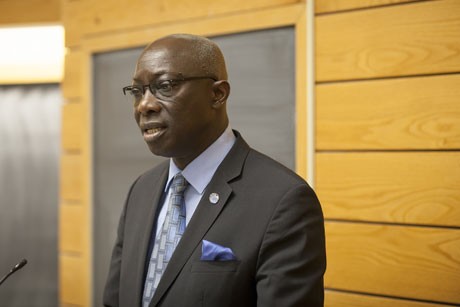
Jason Koski/University Photography
As world leaders gathered in Kigali last week to commemorate the 20th anniversary of the Rwanda genocide, Adama Dieng, the United Nations secretary-general's special adviser for the prevention of genocide, reflected on the tragedy in a roundtable discussion on campus April 18. Dieng and his fellow panelists discussed issues surrounding the genocide and lessons the international community has learned since the massacre. The Rwanda genocide in early April 1994 was the result of tensions between two native ethnic groups, the Hutu and the Tutsi. Many Hutu blamed the Tutsi for Rwanda's economic struggles, and when the Hutu president was assassinated, the Hutu implemented a mass killing that left 800,000 people - mostly Tutsi - dead. Dieng addressed the U.N.'s failure to prevent or stop the genocide, citing a "well-recognized fact in international relations that no state can interfere with another state without permission." However, the sanctity of the state, created to promote peaceful coexistence between nations, does not grant states permission to violate their citizens' human rights. Since the abysmal international response to the bloodshed in Rwanda, Dieng said, much has changed. At the 2005 World Summit, the U.N. accepted the Responsibility to Protect principle, which asserts that states have a "duty to prevent" crimes like genocide.
TO READ THIS ARTICLE, CREATE YOUR ACCOUNT
And extend your reading, free of charge and with no commitment.