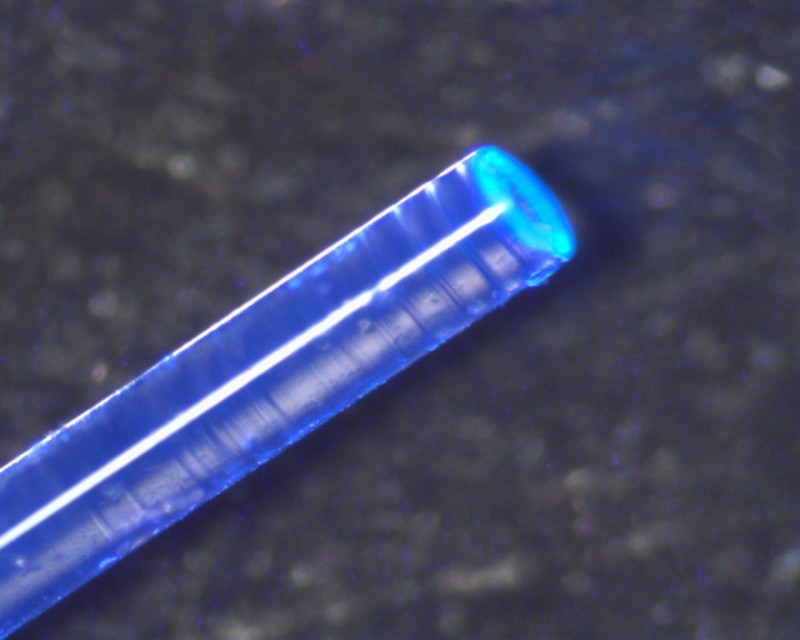
EPFL's physicists are moving forward in their efforts to solve the mysteries of the universe. A particle detector made up of 10,000 kilometers of scintillating fiber is under construction and will be added onto CERN's particle accelerator. The Large Hadron Collider (LHC) at CERN, the European Organization for Nuclear Research, produces hundreds of millions of proton collisions per second. But researchers working on the Large Hadron Collider beauty (LHCb) experiment, which involves physicists from EPFL, can only record 2,000 of those collisions, using one of the detectors installed on the accelerator. So in the end, this technological marvel leaves the physicists wanting more. They are convinced that the vast volume of uncaptured data holds the answers to several unresolved questions. In elementary particle physics, the Standard Model - the theory that best describes phenomena in this field - has been well and truly tried and tested, yet the researchers know that the puzzle is not complete.
TO READ THIS ARTICLE, CREATE YOUR ACCOUNT
And extend your reading, free of charge and with no commitment.
Your Benefits
- Access to all content
- Receive newsmails for news and jobs
- Post ads