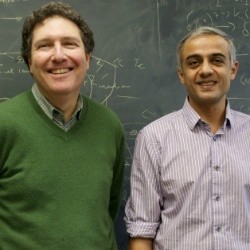
Gary Bernstein and Bhuvnesh Jain
NASA has nominated three U.S. science teams to participate in the European Space Agency's planned Euclid mission, a space telescope designed to probe the mysteries of dark energy and dark matter and scheduled to launch in 2020. The University of Pennsylvania's Gary Bernstein and Bhuvnesh Jain , both professors in the School of Arts and Science 's Department of Physics and Astronomy , are in the ESA-selected group of 43 astronomers who form the largest U.S. team, which is led by the Jet Propulsion Laboratory's Jason Rhodes. "The pristine conditions in space will allow Euclid to take pictures with exquisite clarity, which is evident if you've seen images from Hubble Space Telescope," Jain said. "But Euclid can take pictures faster than Hubble and get infrared images which are simply impossible to obtain from the ground." Euclid will observe up to 2 billion galaxies occupying more than one-third of the sky with the goal of better understanding the contents of the universe. Despite the seeming preponderance of the stuff, everyday matter makes up only a few percent of everything in the cosmos. The remaining contents are sometimes referred to as the "dark universe," as it is made up of phenomena that can't be directly observed. About 24 percent of the universe consists of dark matter, an invisible substance that does not reflect or emit any light but exerts a gravitational tug on other matter.
TO READ THIS ARTICLE, CREATE YOUR ACCOUNT
And extend your reading, free of charge and with no commitment.