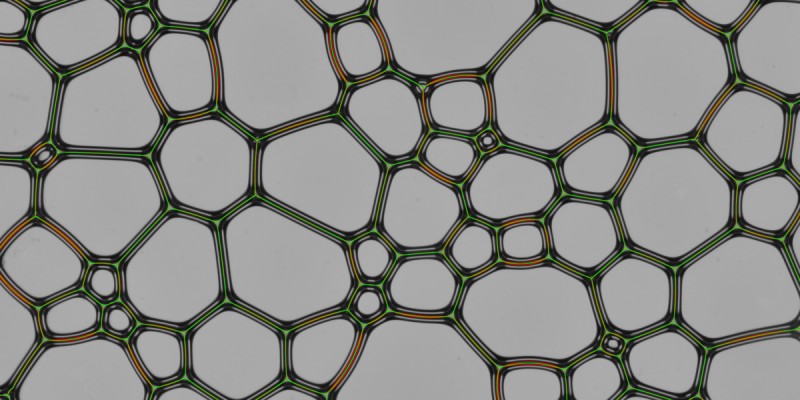
Credit:Â Anthony Chieco
Whether drinking beer, eating ice cream or washing the dishes, it's fair to say that many people come across foam on a day-to-day basis. It's in everything from detergents to beverages to cosmetics. Outside of everyday life, it has applications in areas such as firefighting, isolating toxic materials and distributing chemicals. But there's still a lot to be learned about this ubiquitous material. "Foams are nature's ideal random disordered materials," said Douglas Durian , a physics professor in the School of Arts and Sciences at the University of Pennsylvania. "Ordered solids, materials with a crystalline structure underneath, are easy to describe. Where we don't know a lot, but are still learning, is in systems that are disordered and far from equilibrium, and that's this to a T. You could conceivably make an ordered foam by blowing individual bubbles all the same size and stacking them like cannonballs, but you'd be bound to make a tiny error.
TO READ THIS ARTICLE, CREATE YOUR ACCOUNT
And extend your reading, free of charge and with no commitment.