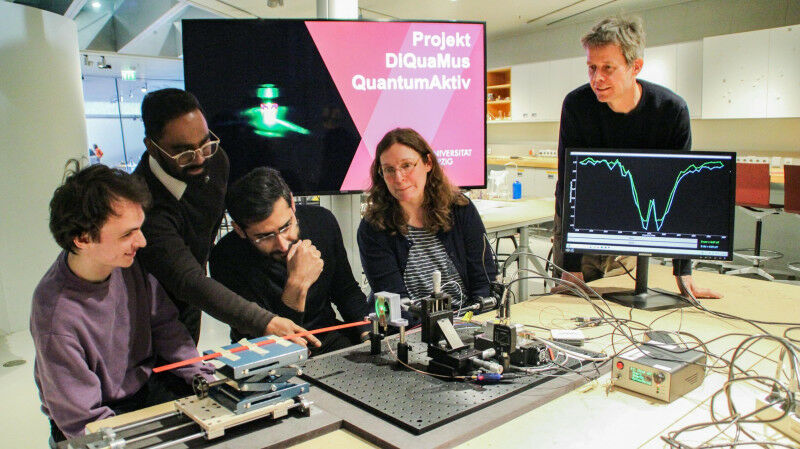
Researchers from Leipzig University and TU Braunschweig have developed an exhibit for a hands-on exhibition at the Phaeno Science Center in Wolfsburg, which aims to bring quantum technologies closer to the general public. The prototype, which will be shown for the first time in Wolfsburg on the occasion of World Quantum Day on April 14, was created under the leadership of physicist Nabeel Aslam from the University of Leipzig and is part of the project "Quantum Technologies in Museums: Hands-on Diamond Quantum Sensors" (DiQuaMus). It is funded by the Federal Ministry of Education and Research (BMBF) as part of the "Quantum aktiv - Outreach concepts and open innovation for quantum technologies" initiative. In this interview, Prof. Aslam explains the background and aims of the project.
What exactly is the exhibit for the Phaeno Science Center’s hands-on exhibition about?
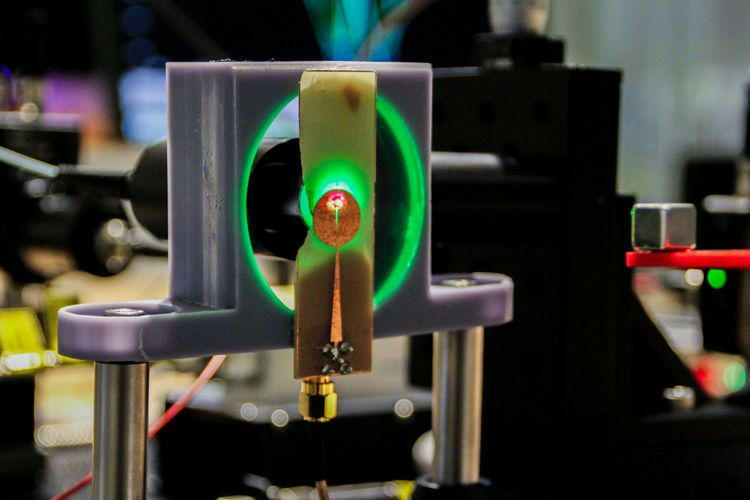
Our exhibit brings quantum technology to touch and try out for yourself! We show how so-called nitrogen-vacancy centers, NV centers, in diamonds can be used as extremely sensitive quantum sensors for magnetic fields. Visitors can directly experience how these quantum sensors work and what makes them so special.
How long will the exhibit be on display in Wolfsburg and what can visitors to the center do with it?
We have delivered an initial prototype of our exhibit to the Phaeno Science Center. In close cooperation with the Phaeno team, it is now being intensively tested and further developed there in order to optimally integrate it into the hands-on exhibition. This is not just about technical functionality and safe, intuitive operation, but also about designing the exhibit in such a way that it arouses curiosity and appeals to visitors both visually and in terms of content. As soon as the final version is ready, the exhibit will be permanently included in the exhibition. Visitors will then have the opportunity to experiment with real quantum technology for themselves: They can measure magnetic fields and experience live how a quantum sensor based on NV centers works - interactively, tangibly and playfully conveyed.
How did the idea for such an exhibit come about and how long did it take to develop the prototype?
The idea came about when I visited the Phaeno Science Center with my children and was amazed at how complex scientific phenomena are made tangible through interactive exhibits. I wondered whether this would also be possible with a subject as abstract as quantum technology. After discussions with the Phaeno team and the physics didactics department at TU Braunschweig, it was clear that this was exactly what we wanted to try together. We then successfully applied for the BMBF’s "Quantum Aktiv" call for proposals, which made the implementation possible in the first place. The development of the prototype then took about a year - from the concept to the first finished interactive station.
What happens to it after the exhibition?
After the exhibition, we will check whether the exhibit can continue to be used at other museums or science museums. It will also be used for educational purposes in schools to teach quantum physics in a vivid way.
This is your contribution to World Quantum Day on April 14. What else is happening in Germany to mark this day?
World Quantum Day on April 14 refers to the number 4.14 - the rounded first digits of Planck’s constant - and thus honors one of the central quantities of quantum physics. Events are held around the world on this day to make quantum research accessible to the general public - including in Germany with lectures, workshops and hands-on activities. 2025 is also the "International Year of Quantum Science and Technology", which looks back on 100 years of modern quantum physics. The groundbreaking paper by Werner Heisenberg from 1925 - the starting point of quantum mechanics - will also be celebrated. Heisenberg became a professor in Leipzig a few years later, which gives the city a special connection to the history of quantum physics.
In addition to this transfer project, your working group mainly conducts research into applied quantum technologies, including in your BMBF project DiamondNanoNMR. What is this about?
In our BMBF project DiamondNanoNMR , which is funded with 4.9 million euros from 1.12.2022 to 30.11.2027, we are concentrating on making quantum technology usable for practical applications in biochemistry and biomedicine. Our main focus is on the use of NV centers in diamonds to measure magnetic signals with high precision on the nanometer scale. In the long term, this could become important in many areas - for example, in biochemistry to analyze individual molecules or in materials science to understand the properties of new materials at the atomic level.