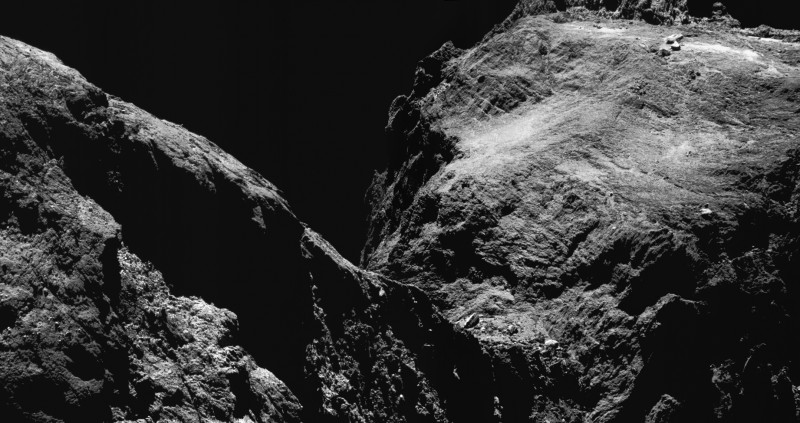
Image of the comet from the end of May 2016 as Rosetta flew as closely to the cometary fog as possible over a course of three weeks (between 5 and 8 km distance), to allow ROSINA to "sniff out" the xenon isotopes. â’ ESA/NAVCAM
Media releases, information for representatives of the media Media Relations (E) The difficult yet successful measurement of several isotopes of the noble gas xenon on comet 67P/Churyumov-Gerasimenko using the Bernese instrument ROSINA on the Rosetta probe shows that materials arrived on Earth due to comet impacts. As proven by further Bern measurements of silicon isotopes, in the beginning our solar system was extremely heterogeneous. The high amount of so-called "heavy" water also shows that cometary ice is older than our solar system. Xenon is a colourless, odourless gas that makes up far less than one millionth of the volume of the entire earth's atmosphere. As a noble gas, it rarely reacts with other elements and thus has a relatively stable atomic state. It is therefore a relatively accurate representation of the conditions that existed during the formation of our solar system. Xenon can also help to answer the age-old question about comets: does material on Earth come from comet impacts and if so, to what extent? A research team led by Kathrin Altwegg at the Center for Space and Habitability (CSH) of the University of Bern was able to show that the xenon composition on the comet 67P/Churyumov-Gerasimenko is very similar to the "indigenous xenon" first posited 40 years ago, which arrived on our planet from beyond shortly after the formation of our solar system.
TO READ THIS ARTICLE, CREATE YOUR ACCOUNT
And extend your reading, free of charge and with no commitment.