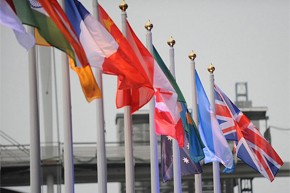
Flags at the G20 Summit in London 2009. Photo by Downing Street
The global financial crisis and the creation of the Group of 20 (G20) have put Asian economies in the driver's seat of world economic affairs. But the region's political and economic architecture needs to be urgently restructured to better reflect this new global reality, says an expert from The Australian National University. According to Professor Peter Drysdale, from the ANU Crawford School of Economics and Government, the rise of bigger powers in Asia and the formation of the G20 mean that traditional forums charged with managing world political and economic affairs are now being superseded. 'The key question now is, how can the political and economic forums which make up regional architecture in Asia and the Pacific be restructured to better reflect and effectively deal with these new global realities,' said Professor Drysdale. 'Regional architecture in Asia and the Pacific is not up to the tasks it now needs to perform and this has been the case for some time. With the G20, which consists of six major Asian economies, including Australia, the region now has a platform at the global level to deliver on its growing international responsibilities. But it is not clear how established regional arrangements can relate to that forum and be engaged to strengthen the region's role in the international economic system.
TO READ THIS ARTICLE, CREATE YOUR ACCOUNT
And extend your reading, free of charge and with no commitment.