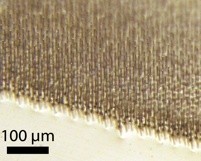
This is a photomicrograph of a silicon wire array embedded within a transparent, flexible polymer film.
PASADENA, Calif.—Using arrays of long, thin silicon wires embedded in a polymer substrate, a team of scientists from the California Institute of Technology (Caltech) has created a new type of flexible solar cell that enhances the absorption of sunlight and efficiently converts its photons into electrons. The solar cell does all this using only a fraction of the expensive semiconductor materials required by conventional solar cells. "These solar cells have, for the first time, surpassed the conventional light-trapping limit for absorbing materials," says Harry Atwater, Howard Hughes Professor, professor of applied physics and materials science, and director of Caltech's Resnick Institute, which focuses on sustainability research. The light-trapping limit of a material refers to how much sunlight it is able to absorb. The silicon-wire arrays absorb up to 96 percent of incident sunlight at a single wavelength and 85 percent of total collectible sunlight. "We've surpassed previous optical microstructures developed to trap light," he says. Atwater and his colleagues—including Nathan Lewis, the George L. Argyros Professor and professor of chemistry at Caltech, and graduate student Michael Kelzenberg—assessed the performance of these arrays in a paper appearing in the February 14 advance online edition of the journal Nature Materials .
TO READ THIS ARTICLE, CREATE YOUR ACCOUNT
And extend your reading, free of charge and with no commitment.