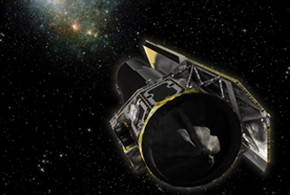
The ANU plasma thruster will help satellites travel for longer and further into deep space. Image courtesy of NASA.
ANU has won a $3.1 million grant from the Federal Government to help propel Australian satellite technology and exploratory missions into the furthest reaches of deep space. The University will partner with national and international bodies to make a revolutionary plasma thruster engine, invented and developed at ANU, ready for spaceflight. If successful, the engine could be used in satellites and deep space missions as soon as 2013. Project leader Professor Rod Boswell, from the Plasma Research Laboratory in the ANU College of Physical and Mathematical Sciences, said the engine will be based on his colleague Professor Christine Charles? Helicon Double Layer Thruster (HDLT). 'The HDLT is the first thruster of its kind in the world and can be used to keep satellites in their desired orbit as well as in interplanetary travel,' he said. 'It is an elegant, almost fuel-independent as well as energy and cost effective, propulsion system. ?Plasma thruster engines are set to be the future of all space exploration and satellite activities.
TO READ THIS ARTICLE, CREATE YOUR ACCOUNT
And extend your reading, free of charge and with no commitment.