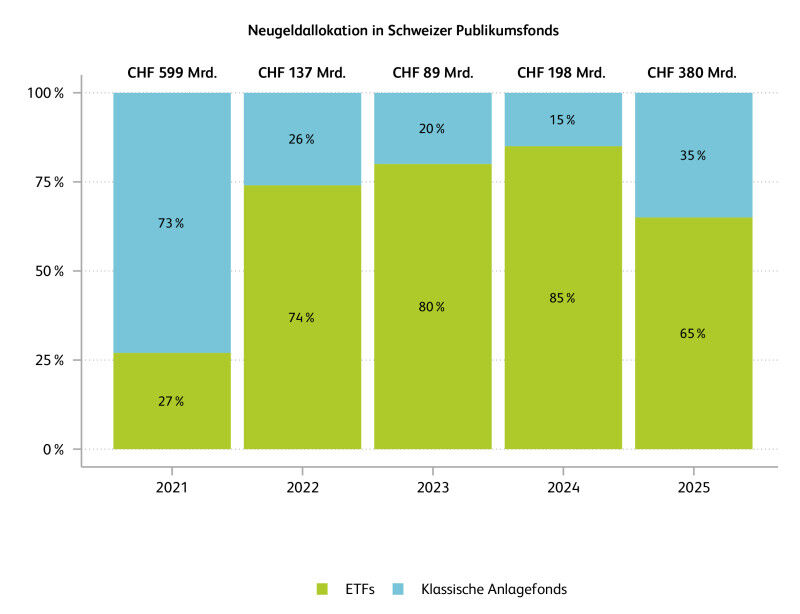
The market for exchange-traded funds (ETFs) is growing at an above-average rate and is increasingly shaping the Swiss fund landscape. Since 2021, new money has been flowing into ETFs rather than traditional investment funds. At the same time, Swiss investors’ knowledge of ETFs varies greatly, particularly with regard to fees. The new ETF investor study by Lucerne University of Applied Sciences and Arts is the first to comprehensively examine the investment behavior and level of knowledge of Swiss investors with regard to this growing market segment.
ETFs are becoming increasingly important in the Swiss fund market. Although they only account for 16% of all investment funds with around 1,500 products, the majority of new money has been flowing into ETFs since 2021 (Figure 1). This trend is likely to continue: 87% of current ETF investors intend to increase their exposure in the next two years, while a third of current non-ETF users are planning to invest in ETFs for the first time.
Paradigm shift from traditional investment funds to ETFs
"ETFs are becoming an important building block in the investments of Swiss investors. The clear tendency to invest new money in ETFs indicates a progressive paradigm shift in investment behavior," says study director Brian Mattmann from the Lucerne University of Applied Sciences and Arts. The paradigm shift is reflected in the fact that investors increasingly prefer low-cost, transparent and passively managed ETFs to traditional, actively managed investment funds. "Instead of relying on the selection of individual securities by fund managers, ETFs enable broad, index-based diversification and easy access to investment markets," explains Timo Böhninger from Finanzen.ch, which commissioned the study.
Swiss ETF investors are young, male and have a high level of ETF knowledge
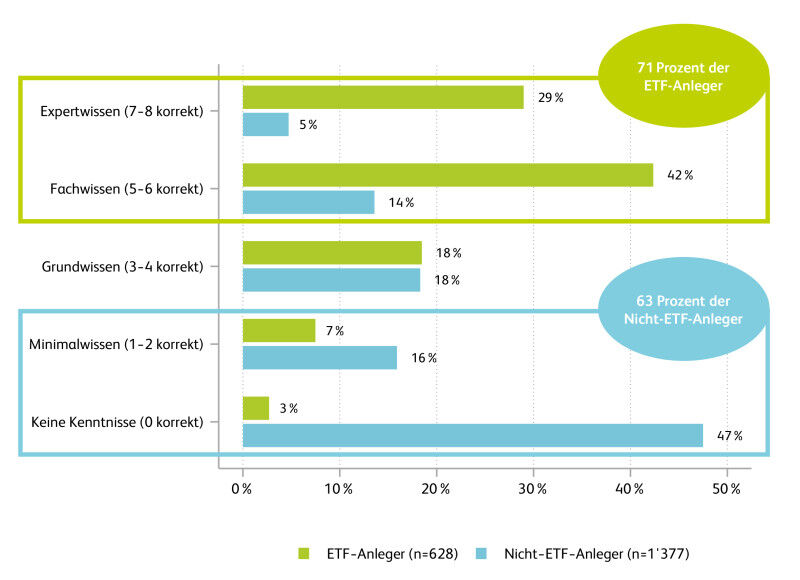
A third of Swiss investors currently invest their assets in ETFs. This group differs significantly from other investors: The majority of ETF investors are younger than 45, predominantly male and have a higher level of education. Digital channels such as financial portals and blogs play a key role in ETF sales for younger investors. Older investors focus more on the recommendations of their bank advisors. The high level of specialist knowledge is striking: 71% of ETF users have specialist or expert knowledge of ETFs, while 63% of non-ETF users lack basic ETF knowledge (Figure 2). ’For ETF sales, knowledge transfer and comprehensible product communication are crucial in order to increase trust and willingness to buy,’ says Mattmann, head of the study.
Investors underestimate the price advantage of ETFs
ETF investors particularly appreciate the diversification and low costs of ETFs. Their willingness to invest depends heavily on the level of fees. Non-ETF investors, on the other hand, are hardly influenced in their willingness to invest by lower product fees, although they also state that product fees are very important. Although Swiss investors are generally very cost-conscious when it comes to financial investments, it is usually difficult to assess the actual fees.
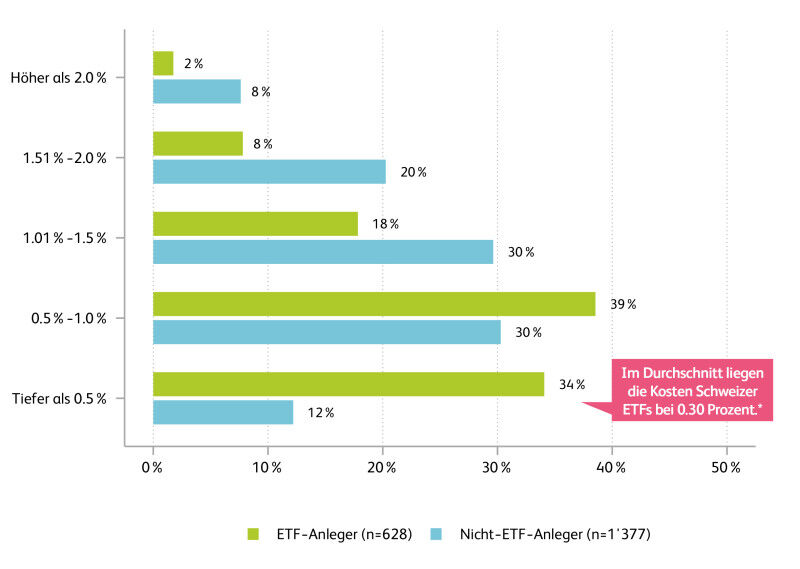
In contrast, the price advantage of ETFs is underestimated by all investor groups: 58 percent of non-ETF users estimate the fees of ETFs at over one percent. Even many ETF investors overestimate the actual costs, which average around 0.30 percent for Swiss ETFs (Figure 3). "The results show that ETF providers can use investors’ pronounced cost awareness to position ETFs as a particularly cost-efficient form of investment," explains co-author of the study Jürg Fausch. "However, providers must be able to explain the cost advantage in an understandable way," continues Fausch.
ETF fund savings plans offer growth opportunities
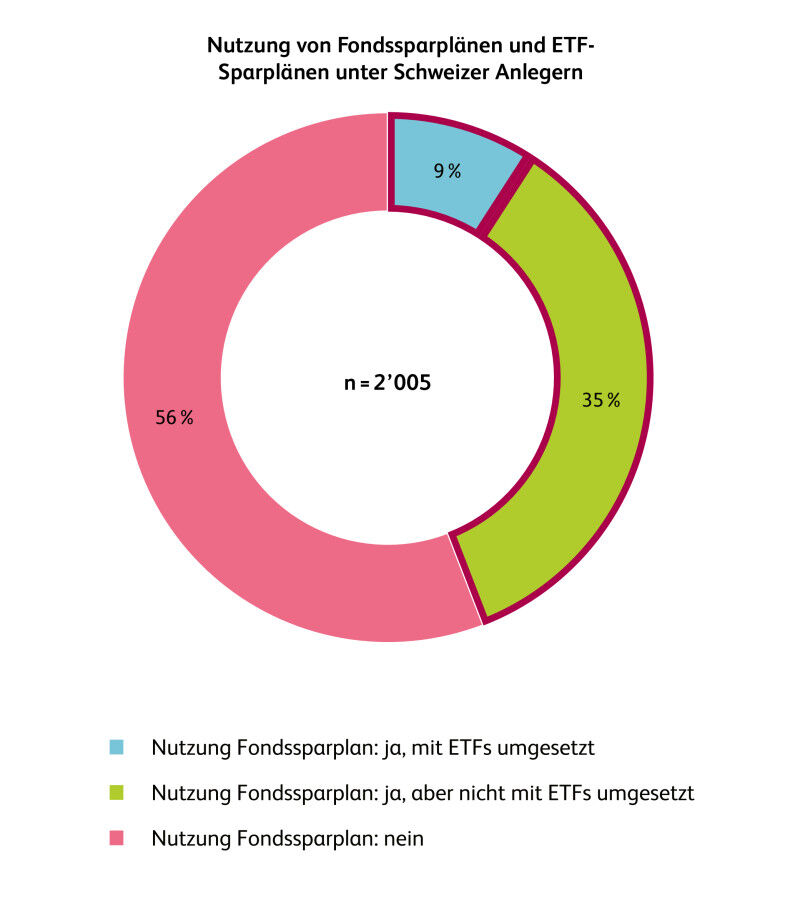
44 percent of Swiss investors use fund savings plans. However, the clear majority of these investors use traditional investment funds, with ETF fund savings plans only playing a subordinate role to date (Figure 4). ’In Switzerland, ETF fund savings plans are still a young investment instrument and therefore still have a comparatively low penetration rate,’ says co-author of the study Karsten Döhnert. However, the market potential of ETF fund savings plans is high: almost half of ETF investors are interested in buying an ETF fund savings plan. Looking at the purpose of fund savings plans, it is clear that around three quarters of fund savings plan investors use them to build up assets for private retirement provision (pillar 3a).
ETF investor study Switzerland 2025
The ETF Investor Study Switzerland 2025 by Lucerne University of Applied Sciences and Arts (HSLU) presents the first comprehensive analysis of the investment behavior and level of knowledge of Swiss investors with regard to ETFs. It provides a well-founded overview of this dynamically growing investment segment.
Finanzen.ch conducted a representative survey of 3,460 people aged 18 to 75 in German-speaking and French-speaking Switzerland from April 29 to May 8, 2025 with the Swiss market research institute intervista. The survey was representative in terms of age, gender and language region.
The study is available digitally here and in a web-based version on Finanzen.ch.