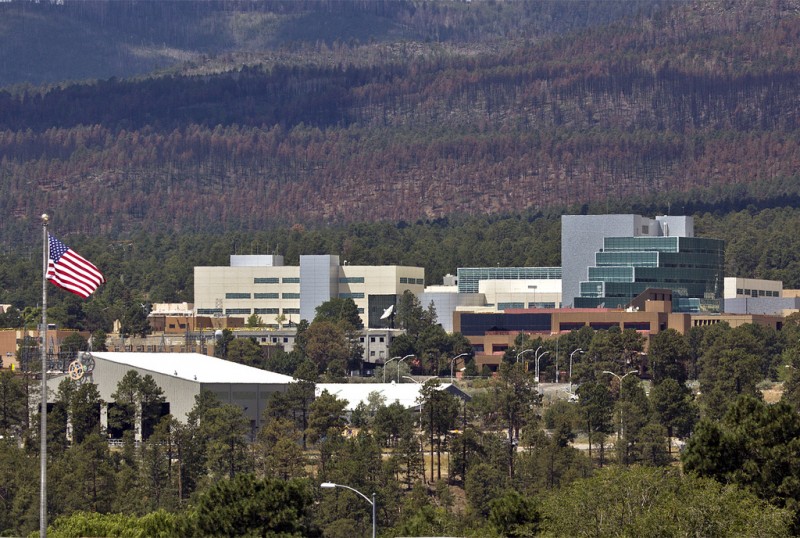
Los Alamos National Laboratory sits on top of a once-remote mesa in northern New Mexico with the Jemez mountains as a backdrop to research and innovation covering multi-disciplines from bioscience, sustainable energy sources, to plasma physics and new materials.
Scientists use supercomputer to model a fundamental process in physics that could help explain how stars begin to explode into supernovae. Los Alamos, New Mexico, November 16, 2009 — Despite decades of research, understanding turbulence, the seemingly random motion of fluid flows, remains one of the major unsolved problems in physics. "With the Roadrunner supercomputer, we can now look in detail at previously inaccessible flows,” said Daniel Livescu, of Laboratory's Computational Physics and Methods group. Involving a technique known as Direct Numerical Simulations (DNS), researchers use the exact equations of fluid flow to calculate pressures, densities, and velocities, at very high resolution for both time and space, high enough to resolve the smallest eddies in the turbulent flow. This makes the DNS results as "real” as experimental data but requires immense computer power. In many instances, these simulations are the only way turbulence properties such as those found in cosmic explosions like supernovae can be accurately probed. In these cases, turbulence is accompanied by additional phenomena such as exothermic reactions, shock waves, and radiation, which drastically increase the computational requirements.
TO READ THIS ARTICLE, CREATE YOUR ACCOUNT
And extend your reading, free of charge and with no commitment.