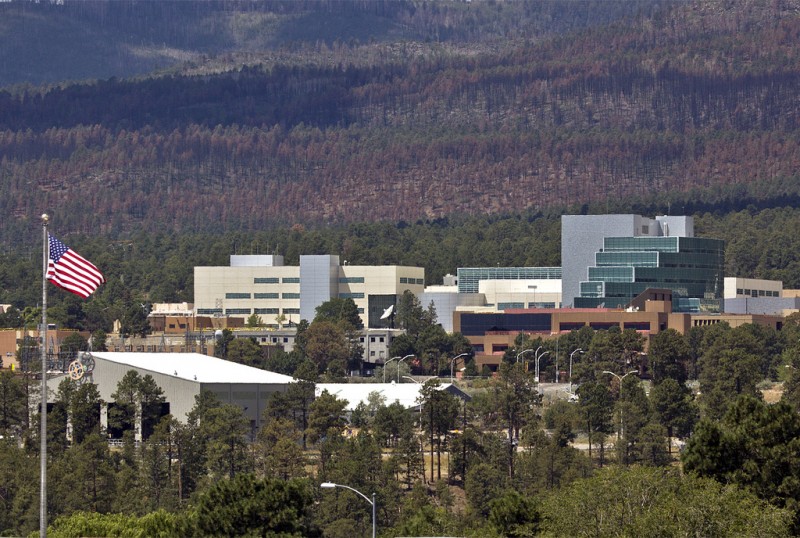
Los Alamos National Laboratory sits on top of a once-remote mesa in northern New Mexico with the Jemez mountains as a backdrop to research and innovation covering multi-disciplines from bioscience, sustainable energy sources, to plasma physics and new materials.
The mission will not only be able to search for planets around other stars, but also yield new insights into the parent stars themselves. NASA Kepler spacecraft set to launch today LOS ALAMOS, New Mexico, March 6, 2009—The Kepler space telescope is set to launch today from the Kennedy Space Center in Florida at about 8:50 p.m. MST, and a group of scientists at Los Alamos National Laboratory will be watching with keen interest. Four stellar seismologists at the Laboratory are part of the Kepler Asteroseismic Science Consortium, a large, multinational team that will analyze the vast quantity of data expected from the mission. Using Kepler, NASA expects to answer a very fundamental question: do planets the size of Earth exist in orbit around other stars? The Kepler Spacecraft is equipped with a large telescope that will measure the variations in brightness of 170,000 stars simultaneously and continuously for a period of at least 3.5 years. The mission will not only be able to search for planets around other stars, but also yield new insights into the parent stars themselves. Kepler's measurements of changes in stellar brightness can also be used to study stars and their interiors. Consortium team members at Los Alamos include Joyce Ann Guzik, Paul Bradley, Arthur N. Cox, and Kim Simmons.
TO READ THIS ARTICLE, CREATE YOUR ACCOUNT
And extend your reading, free of charge and with no commitment.