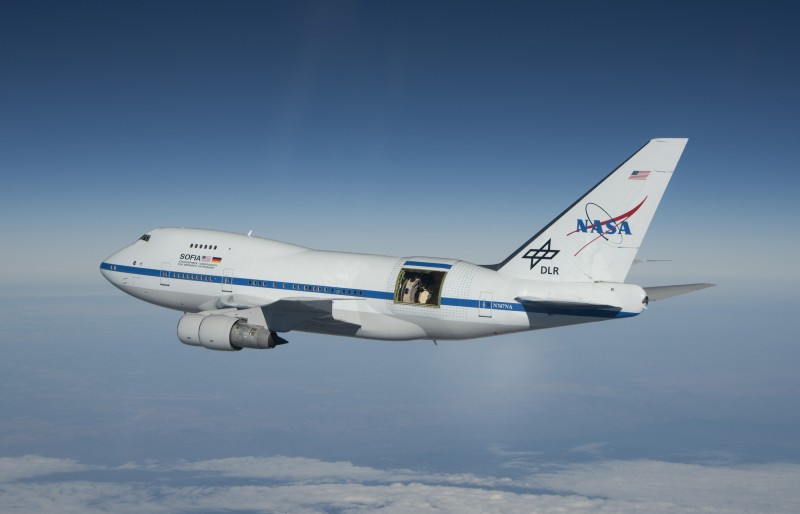
 The Boeing 747-SP with the Stratospheric Observatory for Infra-red Astronomy SOFIA, a project of NASA and DLR (German Aerospace Centre).
Media releases, information for representatives of the media Media Relations (E) Researchers from the University of Bern, using an observatory on board a jumbo jet, have observed how the extrasolar Planet GJ 1214b is passing in front of its star, causing a kind of mini-eclipse. The first measurements of this kind with the observatory called SOFIA (short for Stratospheric Observatory for Infra-red Astronomy) prove that the flying observatory is well-suited to the observation of exoplanets. SOFIA is a 2.5-metre telescope, built into a Boeing 747-SP - an American-German project. "The observatory flies somewhat higher than commercial aeroplanes," explains Daniel Angerhausen of the Center for Space and Habitability (CSH) of the University of Bern: "In this sense, SOFIA is a space telescope that returns home every morning." The CSH researcher had already completed several test flights, but the most recent observations have been unprecedented. "For the first time, we were able to use all the instruments available on SOFIA to research my speciality: transits of extrasolar planets," explains Daniel Angerhausen. When, from our vantage point, a planet outside the solar system passes directly in front of its parent star, the planet occults parts of the star and makes it a little darker as in a mini-eclipse. Part of the starlight, however, passes through the planet's atmosphere before reaching us.
TO READ THIS ARTICLE, CREATE YOUR ACCOUNT
And extend your reading, free of charge and with no commitment.
Your Benefits
- Access to all content
- Receive newsmails for news and jobs
- Post ads