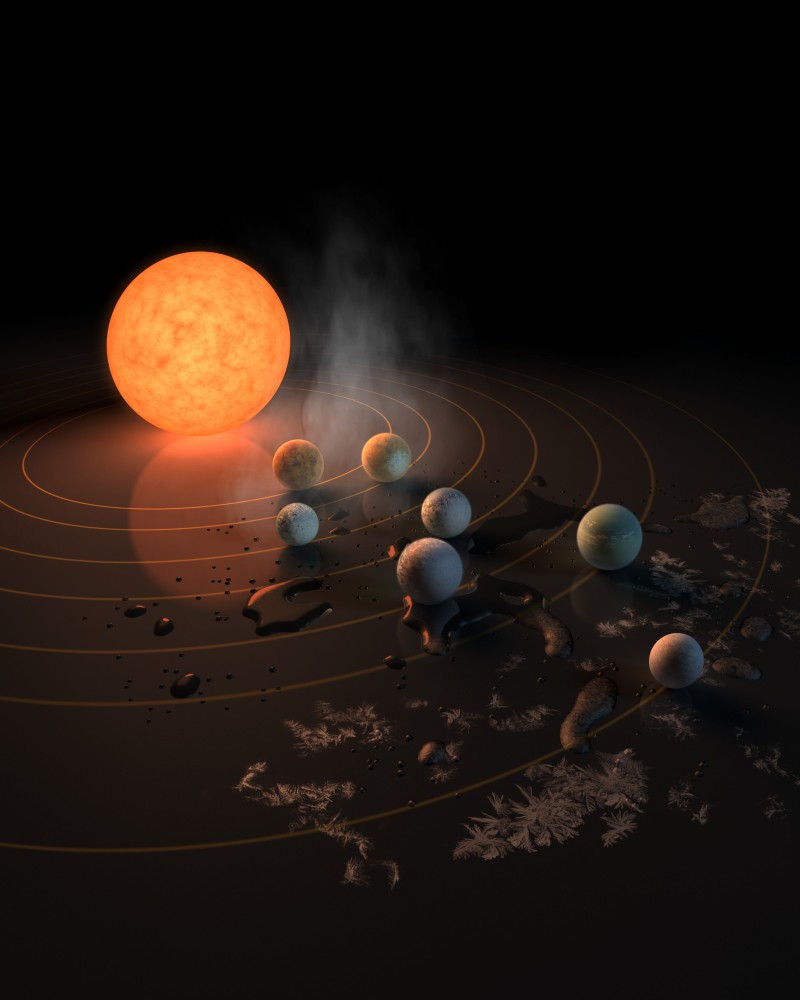
 Artist’s impression of the TRAPPIST-1 planetary system.
An international team of astronomers has discovered a compact analogue of our inner solar system about 40 light-years away. Brice-Olivier Demory of the Center of Space and Habitability at the University of Bern, analysed the data collected with NASA's Spitzer Space Telescope and calculated that the newly detected exoplanets all have masses less or similar to the Earth. TRAPPIST-1 is the name of the small, ultracool star that is the new hot topic in astronomy and the search for life outside our solar system. Observing the star with telescopes from the ground and space during an extensive campaign, an international team found that there are at least seven terrestrial planets around TRAPPIST-1. Their temperatures are low enough to make possible liquid water on the surfaces, as the researchers report in the journal 'Nature'. 'Looking for life elsewhere, this system is probably our best bet as of today', says Brice-Olivier Demory, professor at the University of Bern's Center for Space and Habitability and one of the authors of the 'Nature' paper. The configuration of these exoplanets orbiting a dwarf star makes it possible to study their atmospheric properties with current and future telescopes.
TO READ THIS ARTICLE, CREATE YOUR ACCOUNT
And extend your reading, free of charge and with no commitment.
Your Benefits
- Access to all content
- Receive newsmails for news and jobs
- Post ads