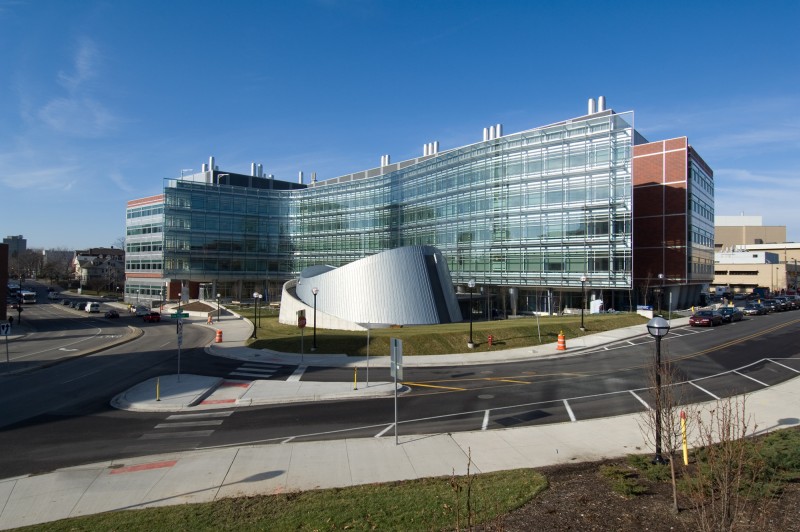
A. Alfred Taubman Biomedical Science Research Building
ANN ARBOR-A new University of Michigan study shows that when researchers share a building, and especially a floor, the likelihood of forming new collaborations and obtaining funding increases dramatically.'? The findings have wide relevance to corporations, as well. "Our analyses clearly show that there are benefits to co-location," said Jason Owen-Smith, an associate professor of sociology and organizational studies. Researchers who occupy the same building are 33 percent more likely to form new collaborations than researchers who occupy different buildings, and scientists who occupy the same floor are 57 percent more likely to form new collaborations than investigators who occupy different buildings, he said. Owen-Smith is the lead author of a report titled "A Tale of Two Buildings: Socio-Spatial Significance in Innovation" ( http://bit.ly/NCRCReport ). The report details the findings of a two-year study funded by the U-M Office of the Vice President for Research, the U-M Institute for Social Research and the U-M Medical School. For the study, the research team conducted surveys of 172 faculty and research staff members in three U-M buildings, and also used administrative data to assess collaboration and physical proximity. The buildings were the North Campus Research Complex, the A. Alfred Taubman Biomedical Science Research Building and the Comprehensive Cancer Center.
TO READ THIS ARTICLE, CREATE YOUR ACCOUNT
And extend your reading, free of charge and with no commitment.